Tag: The Robb Review

Reader’s Theater: Develops Joyful Reading, Fluency, & Comprehension

By Chase Young

I once asked a second-grade boy if Reader’s Theater made him a better reader, and he responded, “No, because it’s fun.” He was a reluctant reader, but he loved the interaction during rehearsal and entertaining his peers during the performance. So, I suppose he was a reluctant silent reader but loved reading aloud with his friends and classmates. You could tell he enjoyed it more than any other activity because he was always smiling when he rehearsed and performed.

Regardless of what this second grader thought, Reader’s Theater was helping him become a better reader, which is also true for many other students. Research says that Reader’s Theater is an excellent way to improve reading fluency, comprehension, vocabulary, and confidence (Millin & Rinehart, 1999; Young et al., 2019). Improving these combined aspects of reading results in an increase in overall reading achievement. A recent meta-analysis found that Reader’s Theater has a large impact on students’ reading proficiency (Mastrothanasis et al., 2023). So, I encourage you to give it a try.

Reader’s Theater is essentially a group of students who dramatically read a text for an audience. All you need are some kids, a few scripts, and five to ten minutes per day.
Although there are many ways to implement Readers Theater in your classroom, I will share a method that worked well for my second graders and me. Feel free to adapt the following to meet the needs of your students and unique teaching style.

Selecting Scripts reading skills
I use a five-day format that helps students prepare for our weekly performances. Each day our rehearsals focus on different aspects of reading; we begin the week with decoding and end the week with fluent, expressive reading.

Before the week begins, I select three to six different scripts for the students to choose from. The number of scripts depends on your class size and the number of parts in each script. The scripts are usually based on popular novels, but I also include nonfiction, poetry, or speeches. In fact, I even use scripts from movies, such as A Christmas Story—the students really enjoy performing the “flagpole” scene.

While you can turn almost anything into a Reader’s Theater script, my website has over 200 free ready-to-download from www.thebestclass.org. Of course, once students become comfortable with Reader’s Theater, I encourage them to write their own scripts based on my read-alouds or books they’ve read. Teachers can also write scripts to match their students’ interests or topics in content areas. The key is to provide scripts that you think your students will love and enjoy performing.  

Five-Day Format
Teaching Reading Skills


On Monday, I read the scripts to my students, and they form groups based on their choice of script. At that time, I ask students to read the entire script and think about the overall meaning of the text.

On Tuesday, the students choose their parts. It is a little chaotic in the beginning of the year, but remember, Rock, Paper, Scissors solves everything. So, when your wonderful little people begin to argue over parts, break those hands out and try your luck at a best out of three matches.

After the students select and highlight their parts, we focus on decoding and word recognition accuracy; I make sure that students know all the sounds and words and that they can pronounce them accurately and automatically.

On Wednesday, we focus on expression—often referred to as prosody. The students practice reading expressively by calibrating their voice inflection, tone, volume, pitch and pauses for dramatic effect.

Students need a deep understanding of the script to render expressiveness that matches the author’s intended meaning. I offer assistance and also encourage the students to coach each other with the goal of producing appropriate prosody.

On Thursday, we have a practice performance. It is a time for any last-minute tweaks or suggestions from the teacher or peers. When students need additional assistance with their parts, I meet with them one-on-one and choose from a variety of interventions such as echo reading, repeated reading, or choral reading. The goal is to ensure that every student sounds great during the performance.

Once the students and I feel they are ready, we look forward to the last day of the five-day format: performance day. By this time, the students have engaged in daily rehearsals, which is an artful and authentic synonym for repeated reading.

Substantial research exists that promotes the method of repeated readings, and Reader’s Theater research acknowledges the power of practice but also includes a purpose—we believe that if you are going to read a text repeatedly, there better be a good reason. That reason is the performance.

On Friday, we perform. But first, it is important to secure an audience. You can invite parents, other classes, administrators, and other school staff, or take your show on the road!

Tips for Successful Reader’s Theater
Teaching Reading Skills
Here are a few recommendations that I’ve curated from experience.

  • Use challenging texts; they have plenty of support and time to rehearse.
  • Use challenging texts for another reason; I do not want students to memorize the texts; I want them to read their parts.
  • Select texts based on what your students will enjoy performing and will also engage the audience.
  • Incorporate daily activities related to decoding, vocabulary development, and expressive reading. I, along with Faida Stokes and Tim Rasinski, wrote an article for The Reading Teacher in 2017 titled “Reader’s Theater Plus Comprehension and Word Study,” which has daily activities beyond rehearsal that you can access and review.
  • Set a timer for rehearsals each day, allowing for at least two rehearsals.
  • Tell students there are no props or costumes. You don’t want a student to show up dressed like a farmer or an astronaut on Friday.
  • Find an audience. If you cannot, go to the front desk; someone is always there willing to attend.
  • Print extra scripts because students often lose them.  

Some Interesting Results

There are many studies that suggest Reader’s Theater is an effective reading activity, but I’d like to share the results of one in particular. A study we conducted (Young et al., 2019) showed that Reader’s Theater had a profound impact on boys. The three pretest measures—decoding, word knowledge, and comprehension—revealed a gap in favor of the girls. By the end of the study, that gap had closed. We were shocked at these unexpected results but also excited to share that we found something that might help boost reading achievement among boys. An analysis of the survey revealed that most boys liked Reader’s Theater because of the interaction and humor and because it was a novel activity.

Conclusion
Teaching Reading Skills
Readers Theater is a lot of fun (my students and I can attest to that). But more importantly, it can improve many aspects of their reading, including reading fluency. Fluent readers do not have to focus on decoding as much and, therefore, can redirect their attention to reading comprehension, which is the main goal of reading.

So, download some scripts, prepare your little thespians, and integrate the science and art of reading instruction into your classroom.

References

Mastrothanasis, K., Maria Kladaki, M., Aphrodite Andreou, A. (2023). A systematic review and meta-analysis of the Readers’ Theatre impact on the development of reading skills. International Journal of Educational Research Open, 4, 100243.

Millin, S. K., & Rinehart, S. D. (1999). Some of the benefits of readers theater participation for second‐grade title I students. Literacy Research and Instruction, 39(1), 71-88. Doi: 10.1080/19388079909558312

Young, C., Durham, P., Miller, M., Rasinski, T., & Lane, F. (2019). Improving reading comprehension with readers theater. Journal of Educational Research, 112(5), 615-626.

Young, C., Stokes, F., & Rasinski, T. (2017). Readers Theater plus comprehension and word study. Reading Teacher, 71(3), 351-355.

Loading

The Power of Poetry – One Powerful Story

By Timothy Rasinski and Lois Letchford

In a previous posting on the Robb Review (9.12.2020),  I (Tim) described how much poetry has to offer for the teaching of reading.  It is an engaging, joyous reading, and it offers opportunities to develop essential reading competencies in students.   However, one of the most significant attributes of poetry is its ability to improve the reading outcomes of children identified as dyslexic or learning disabled and, indeed all children who struggle to become proficient readers.  

The brevity of most poetry for children as well as the rhythmical, melodic, and rhyming patterns in poetry (and songs) allow even the most struggling of readers to achieve success.    Research tells us that human beings have what appears to be an innate ability to detect patterns in our environment.   Seeing patterns allows us to better negotiate our worlds.    The patterns in poetry allow children to negotiate their language worlds.   All of us know young children who have learned to recite the words to a familiar rhyme or song.  While memorizing the lines of poetry and songs is not reading per se, giving children visual access to the written words in those poems and songs can be a beginning step to reading.    

Several years ago, I met an amazing woman named Lois Letchford.  She had just written a book entitled Reversed which described the journey that she and her dyslexic son Nicholas who went from “learning disabled” to a skilled reader, and highly successful adult. Writing and using poetry was one major transformative component of our literacy story.   

Lois’ Story:

In 1994, my son Nicholas went into first grade. He failed. Throughout this year, he bit his fingernails, wet his pants, and stared into space. At the end of the year, standardized testing sealed expectations revealing he could read ten words, displayed no strengths, and had a “low IQ.”  

I had the opportunity to homeschool Nicholas for six short months, hoping for a turn-around. Armed with a book series labeled, “Success for All,” I too, failed. Stress levels skyrocketed, and progress remained at zero. 

It was my mother-in-law who came to my rescue, offering simple yet profound advice: “Lois, put away what isn’t working and make learning fun.” Her words compelled me to reevaluate my approach to this daunting challenge. But where should I begin? Where did Nicholas excel? Her advice encouraged me to rethink and redesign my approach. But what could I do?  What could Nicholas do? 

I recalled Nicholas and I previously working with spelling patterns. He could do that. He recognized the patterns and learned all those words. How could I use this strength? 

I thought about rhyming words and how to use them. Could I write a short poem to help Nicholas? When desperation reigns, one can only try to find solutions. 

I wrote one simple poem and read it to Nicholas. We read it together and found the rhyming words. That first poem titled A Mug of a Bug, was a huge success. He relaxed and recalled it. He was engaged, we talked about the meaning, found the rhyming words, and recited the poem.  

One poem led to the next and the next. Each poem added to his knowledge, enjoyment, and purpose for reading and writing. My first poems focused on words with short vowel sounds. Poems then include our travel experiences. One poem was about visits to the thousand-year-old church of St. Nicholas. The memory I treasure is one of Nicholas running ahead of his Grandma to visit it, shouting, “Nana, Nana! They named this church after me!” Connections were growing.

Nicholas’s reading growth appeared slow, each poem seemingly added just a drop into the ocean of required literacy knowledge. Yet, in a poem using the “oo”  words as in ‘cook, look, and book,’ I wrote about the last of the great explorers, Captain James Cook. My poem: 

Captain Cook had a notion there was a gap in the map in the great big ocean.

He took a look, without the help of any book, hoping to find a quiet little nook. 

Captain Cook had a notion there was a gap in the map in the great big ocean,

He took a long look, and filled a whole book which caused the whole world to look! 

Poetry is simple. Ideas embedded in poetry were extraordinary. The exploration of this poem tapped into Nicholas’ curiosity, resulting in his asking questions I could not answer.


“Who came before Captain Cook?”  was his first question.  

“Oh,” I replied, “that’s easy. That was Christopher Columbus.”

“And who came before Columbus?” He shot back.

And I was stunned. It was not a question I had ever considered. His question turned me into a curiosity-driven researcher determined to find answers to his questions. 

Though Nicholas’s knowledge of letters and sounds had grown slowly, his intellectual curiosity was boundless. 

Why was poetry such a powerful tool for Nicholas’s learning? 

Prof Sansislas Deheane’s book How We Learn has a chapter on the four pillars of learning. These pillars are Attention, Active Engagement, Error Feedback, and finally, Consolidation. 

Every day, I had Nicholas’s attention. He was actively engaged in listening, reading, and responding to details of all poems. Poetry was building his knowledge base, providing a purpose for using those challenging letters and sounds and building an understanding of patterns in language. Finally, the consolidation through repetition by reading, writing, and reciting these poems aided growth. 

It took almost 25 years to appreciate the impact of this foundational knowledge. In 2018, Nicholas defied the odds and completed his PhD in Applied Mathematics from Oxford University. 

As for me, my book Reversed: A Memoir tells the longer literacy journey from failure to academic success.

Loading

Comprehension: Weaving Meaning as We Read

By Lester Laminack

If your school experience was like mine, comprehension was an after-reading activity. Many of us remember reading first, then answering questions to prove that we understood. For too long, it seems that comprehension has been seen as the process of giving the right answers to someone else’s questions. To be clear, I see nothing wrong with answering questions. However, consider what is required of the one who asks the questions. That person is reflecting on the text, sequencing information, considering the connections within and beyond the text, summarizing and prioritizing, synthesizing the information, grappling with vocabulary, peeling back layers to explore nuance, and considering the information in relationship to the cultural context and to self. Generating questions, then, may be more complex and more rigorous engagement with text than simply searching for answers to someone else’s questions.

Homework assignments asking students to read a selection or chapter and then answer the questions defined comprehension for me as a student. When I was in the fourth grade, my older brother showed me a “trick” that allowed me to finish the assignment more quickly so we could get outside to play.  He told me to begin with the first question. Jot it down. Then, go to the first heading and begin reading. Often, the language of the question mirrored the language in the first paragraphs of the section. The process became something of a game that went like this: drive the “truck” to the end of the chapter to pick up the question. Then, drive to the next heading in the sequence to collect the language that mirrors the question. Drive that truck to my homework page and dump out the language on the page.  As the “truck driver,” I collected, transported, and delivered the information. I did not, however, engage with that information. I did not weave my own threads into those laid down in the text. And I certainly did not examine any threads for bias, stereotype, perspective, accuracy, or any efforts to influence my perception of truth.  Nor did I pause to examine whether the perspective gave privilege to some ideas at the expense of others or question whether there may be other perspectives that may be missing or deliberately omitted. In fact, as a child in school, it never occurred to me that a school textbook would include anything other than the absolute and unbiased truth.

We know that comprehension is more than giving the right answers to someone else’s questions. It involves engagement and interest, concepts and thought, background knowledge, a rich vocabulary, and a command of language. Comprehension calls upon the reader to question, probe, and push back to move forward. It involves weaving all this together to create something new for the reader, something that leaves them changed. Comprehension requires the reader to take information and ideas from the writer and connect them with their own experiences, conceptual understandings, and background knowledge to weave meaning that is relevant to them, which will likely result in unique insights for each reader.

Although approaches to reading instruction vary, the result must be that the reader has understood the text and made relevant meaning from that engagement. Beyond the ability to decode the print and say the words on the page, this requires the reader to bring a conceptual understanding, background knowledge, and vocabulary related to the topic of focus. It requires an ability to make connections between what is already known and what is newly presented in the text. Of course, a reader can build new vocabulary and develop new concepts through engagement with texts, but in this situation, the text must provide a scaffold that connects to what is meaningful and relevant to the reader. Comprehension is multi-faceted, layered, and nuanced.

To comprehend requires the reader to know but also to think, to question, and to challenge information. To comprehend, we pick up threads put down in the text, but we weave them together with the threads of our own experiences, thoughts, beliefs, and opinions. If we are not conscious, our own biases become one of the threads we add to the weave; our notions of right and wrong, the stereotypes that have quietly become part of our unchallenged truth, become a thread.  Therefore, the meaning we make will be ours.  It may include threads of meaning shared by other readers, but each reader weaves their own “truth.”

The reader who consciously examines their own biases and stereotypes as they read and examines the text with attention to the presence of bias stereotype will question and actively seek additional voices and presentations of the information in search of a more nuanced and robust truth.

Throughout most of my early school years, I would have said that the one who could answer the questions was the one who had the best comprehension. If asked to write a definition or to describe what comprehension is, what would your students write? What might their responses reveal to you about where our instruction needs to be tweaked?

For more in-depth discussion and sample lessons, see Critical Comprehension: Lessons for Guiding Students to Deeper Meaning Katie Kelly, Lester Laminack, and Vivian Vasquez (2023) Corwin.

Loading

Books Make Us Better

By Dennis Schug

Do you ever stop to think about the chapters of your “reading life”?

We’ve all got them.  What are the highlights of your chapters?

It’s been a while since I’ve thought about my reading life, let alone written a new chapter.  That is, until now.  

This season is providing time and space to reflect.  It’s giving me confidence to take action.

My Reading Life: Chapter 1

“Today a reader, tomorrow a leader.” – Margaret Fuller

Some of my earliest childhood memories include being surrounded by words: rich and colorful storytelling, adults who value words, written and spoken, and of course, books.  I read nightly bedtime stories and taught early and often to borrow books from the public library.  At 10 years of age, I’d ride my bicycle to meet the local public library’s summer bookmobile, which uncoincidentally was eventually filled with books from my favorite authors and genres.  Working at the public library as a high school student, I read nearly as many books as I was responsible for reshelving.  As a teacher, I began to remember our classroom library, which I made sure was stocked with more books than there was bookshelf space to hold them.  As a teacher leader, I simultaneously pursued certifications in literacy and school leadership.  Decades later, as a parent, I was afforded opportunities to “spoil” my own children with the gifts of words, like I once was.  I remained a voracious lifelong reader, especially of certain topics and genres.  I knew books made me better for others.

I recognize how fortunate I am to have grown up like this and to have circumstances that have helped me sustain an active reading life.  This has driven me to be a “reading principal,” discussing books with anyone willing to engage.  It’s my responsibility to model being a lifelong reader, create space for others to share, and for students to explore their own reading lives.

My Reading Life: Chapter 2

“The comeback is always stronger than the setback.”  – Unknown.

This became a mantra as our school communities courageously faced, navigated, and conquered myriad challenges of global pandemic times.  Priorities shifted from “getting lost in a good book” to ensuring students had resources to meet basic human needs.  What educators “had to do” replaced what we “got to do.”  Like so many, I found myself leading a team focused on others’ health, safety, and wellness.  It wasn’t only a top priority; it was the only priority.  I was and am fortunate.

The reading life I once knew changed suddenly and drastically.  I felt constantly distracted.  I had difficulty sustaining attention on any reading materials besides critical information to aid our team’s focus on doing what’s best for students.  

In quieter moments, I’d try losing myself in a book but found I just couldn’t.  I was not alone.  The more I spoke with others, the more this seemed to be a common challenge.  We were in survival mode.  After a while, we wondered if or when we’d return to more typical times.

Sometimes, we sensed a slow crawl, walk, and occasional run toward the comeback.  

We wondered, when was it that we’d return to doing what we “get to do”?  

My Reading Life: Chapter 3

“Mood follows action.” – Rich Roll

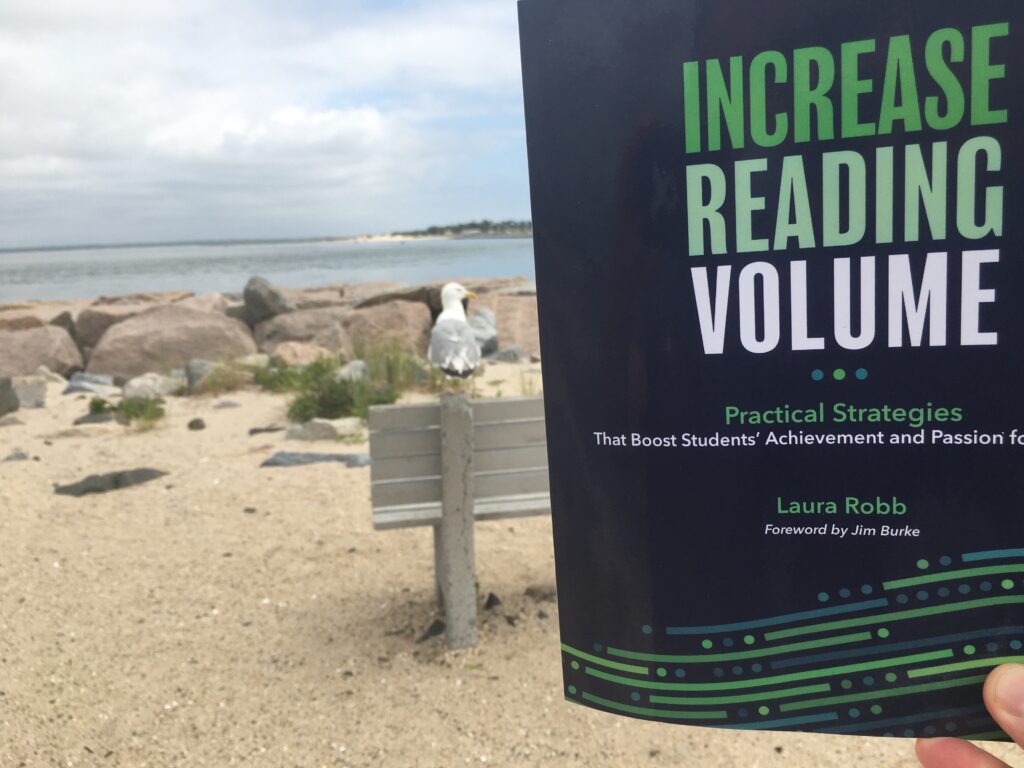
At the end of another school year (our first with sustained typical routines), I was thrilled to get my hands on a copy of Laura Robb’s latest book, Increase Reading Volume: Practical Strategies That Boost Students’ Achievement and Passion for Reading.  While it was among an ambitious stack of books I’d set out to read, it quickly rose to the top of the stack, becoming the literacy masterclass I didn’t know I needed.  

In one of the first sections that resonated with me as a lifelong reader, Robb emphasized the importance of “keeping in touch with your reading life.”

She explains, “A personal reading life enables you to experience the power of visualizing as a path to understanding, the need to talk to someone about a book resonating with you, and that sometimes, reading can be challenging work.  Your enthusiasm for and engagement in reading can rub off on students as they choose books they want to and can read, ensuring they will be engaged” (Robb, 2022).

These are precisely the words I needed to reignite my purpose for reading.  

My next steps became clear.

My Reading Life: Chapter 4

“Every action you take is a vote for the type of person you wish to become.” 

James Clear

First, I listed books I’d been meaning to read, reread, or give as gifts.  I visited the public library, collected gift cards I’d received to make purchases, and splurged a bit at bookstores.  I made an agreement with myself to read every day – a certain number of pages or a certain number of minutes, whichever came first.  I’d use two bookmarks, one marking my starting point and the other my ending point for each reading period.  I’d keep a calendar, making an X each time I read.  Most days, I met my goal.  Some days. I didn’t.  But I never felt the shame of failure, only the opportunity to try again the next day.  Instead, I said to myself I’d never miss two days in a row, marking off two days’ worth of reading, often meeting or exceeding that goal.  I positioned books wherever they’d be most accessible.  Seeing a book next to my workout clothes, the coffee pot, or my car passenger seat were all regular reminders of my commitment to daily reading.    

To date, I’ve read more words, pages, and chapters than I have in many seasons.  I’m finding each book I read is often replaced by two on my “to read” list.  There’s a good chance I’ll never finish my entire stack.  This renewed habit gives me the confidence to talk with others about exploring the next chapters of their reading lives.  Books are making me better.  Books make us better.

Loading