In our previous blog articles for the Robb Review and elsewhere, we have written about the importance and advantages of poetry for children and how poetry should play a major role in any reading and language arts curriculum. In this current article, we would like to shift the focus from poetry to poets. In the United States, we are blessed with a wide variety of children’s poets, and just in the same way that students learn about the many authors of trade books for children, we feel that students (and teachers) should also learn about the fine poets whose trade is to write for kids.
Most of us have a favorite children’s poet or perhaps even a group of favorite poets. Often these include such great ones as Shel Silverstein, Jack Prelutsky, and A.A. Milne. As great as these poets are, the universe of wonderful poets for children is very large — and we would add worth exploring ourselves and with our students. Poets lead interesting lives that help inform their writing. As students learn of the lives of the poets they read about and hear, they may be able to make connections that will inspire them to write their own poetry.
Angela Knight is an elementary school librarian in Springfield, Missouri. Dr. Knight reads a poem aloud to the students in her school every week during the school year as her way to help foster an appreciation for poetry and encourage teachers to include poems in their daily classroom activities. We think her practice is brilliant in its simplicity and should be passed along to librarians, teachers, and all other adults who read to children.
We’ve all watched long wriggly lines of young fans queue up to meet authors of their favorite chapter books or novels and become tongue-tied with adoration when they hold up their books for an autograph. Do kids line up like that, behave like that, in front of a poet? Perhaps some do, but in general, not so much. Yet in classrooms, when poems are read by teachers and students recite their own favorites, they learn to love poetry. Research thoroughly underscores the benefits of hearing and reading poetry in all grades, especially primary grades. An ongoing challenge is to encourage more teachers to read more poems in more classrooms.
The goal isn’t to make poets famous. It’s to make children (and the adults in their lives) more aware of poets as people. Why? Because the better we know someone, the more interesting they become. How do we do that? There are hundreds of books of good poetry for children available in schools and libraries. Many of them provide a thumbnail description of the poet. Nothing more. What is lacking is a way for students to get to know, more personally, the people who write their poems. Who are they? What were they like when they were kids? Why do they like to make up poems? How did they get started? Why is poetry so important to them? Where do they live? Do they like dogs?
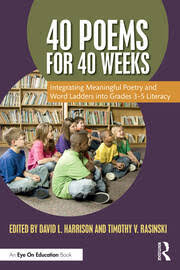
We discussed this challenge with forty well-known poets, all veterans of school visits and literature festivals. We agreed that each one would select or write a poem for our project. We would publish their picture on the first page and a kid-friendly bio on the second. We said, “Introduce yourself the way you do when you are in a school, standing before an audience of students and telling them about yourself.” The third page would feature their poem and a fourth would present a word ladder activity composed for each poem in the book. We asked each poet to suggest other books of poetry, their own or someone else’s, that they recommend for young people. The result was a reference reading list of more than 120 titles to go in the back of the book. The result, 40 Poems for 40 Weeks: Integrating Meaningful Poetry and Word Ladders in Grades 3-5 Literacy, was published by Routledge/Francis-Taylor in 2025.
We believe that moving poetry deeper into the mainstream of reading choices for young people, in the classroom and beyond, will develop a deeper appreciation for poets and the work they do. It will also have a positive impact on developing more fluent and proficient readers. We have found that poetry is an ideal text for developing fluency, the critical bridge from phonics to comprehension, as students must rehearse a poem (i.e., repeated readings) before performing it for an audience of classmates and others. Elementary educators often struggle to find the right materials to fit their instructional goals and schedules. 40 Poems for 40 Weeks, Integrating Meaningful Poetry and Word Ladders in Grades 3-5 Literacy provides a poem and poet for each week of the school year and can be selected in any order. We hope our effort to increase the popularity of poetry and the visibility of poets will inspire others to find ways to approach the goal. Instilling an appetite to read and developing proficiency in doing it remain our top priority as educators, parents, and the general population.
Poetry is rightfully reclaiming its place in the school reading and English language arts curricula. However, poetry does not exist without poets. Learning about the lives of poets who inspire with their poetry may inspire our students to give poetry a try in their own lives.
An excellent supplemental resource is a site called Poetry from Daily Life Free Video Library (https://www.youtube.com/@PoetryfromDailyLife-e2j). Sixty poets, teachers, journalists, editors, and professors have recorded their reasons why they believe that poetry is a vital part of our lives. Among the selections are numerous well-known, respected poets who write for children, including Jane Yolen, Joyce Sidman, Charles Ghigna, Janet Wong, Joseph Bruchac, and David L. Harrison, all of whom read a poem and talk about where they find ideas and how they write their poems. Educators who discuss how to make the most of poetry in the classroom include Laura Robb, Tim Rasinski, and Mary Jo Fresch.
The Importance of Reading Aloud to Children Reading aloud to children plays a vital role in their development for several reasons. First, it immerses children in the rhythms of written language, helping them become familiar with the patterns and sounds that characterize stories and informational texts. The exposure to varied linguistic patterns helps develop an appreciation for the music and potential in written expression. This exposure is foundational for their literacy growth, facilitates a deeper appreciation for language, and helps them become attuned to the nuances of how language can be crafted. Additionally, reading aloud contributes to the enhancement of listening skills. As children follow along with a story, they learn to focus, comprehend, and process spoken words, all of which are necessary for effective communication and learning. Another important benefit is that reading aloud introduces children to a wide range of authors, illustrators, titles, topics, and genres. This variety not only enriches their literary experiences but also encourages curiosity and exploration within the world of books. Furthermore, reading aloud provides children with exposure to multiple points of view on a topic. By listening to stories from various perspectives, children gain a broader understanding of the world and the diverse ways in which people think and feel. Engaging children in read-aloud experiences enables children to think about critical issues that they might not encounter otherwise. Through stories and discussions, children are prompted to consider ideas and dilemmas that foster critical thinking and empathy. Finally, reading aloud provides access to language and ideas, allowing children to encounter new vocabulary, concepts, and ways of expressing themselves. Offering students a shared literary experience and exposure to a diverse body of literature generates a common point of reference, fosters a sense of community, and establishes a basis for thoughtful dialogue about texts. This access is crucial for their cognitive and social development, laying the foundation for success in both academic and everyday settings. The power of rereading is another important aspect modeled during read-aloud experiences. Teachers demonstrate how revisiting a text with a specific focus can reveal new insights and enhance appreciation for the author’s craft. This repeated exposure emphasizes the importance of looking closely, examining ideas, considering perspectives, and questioning what is read.
Selecting Books for Repeated Reading When all members of a classroom share deep and intimate knowledge of a small collection of books, a new level of communication about reading and writing is possible. I recommend beginning with five fiction and five nonfiction titles to revisit throughout the year. When making your selections, consider the following: Does the book have enough depth and substance to merit multiple readings? Do the language and art provide different perspectives for repeated exploration? Are literary elements or text features strong enough to support focused study? Is the information accurate and engaging? Does the writer use craft techniques to help readers construct meaning? Are text features used to clarify, elaborate, or extend information? Can this book serve as a lens for approaching other books? Will this book help build insights that can translate into writing opportunities? *Note, this collection of books for repeated readings is one small part of the read-aloud experiences across the year. There will be many texts that are read in addition to this collection.
Elements of Effective Read-Aloud Experiences Think of the read-aloud experience as a performance art. Read the text aloud a few times before reading it to your students. As you read, think about how your voice will convey the feeling, the intentions, the emotions, and the energy in the writing. Here are four elements to consider as you prepare. Tone I think of tone as the attitude expressed in a piece of writing. It may be chatty and informal, sincere, snarky, caustic, arrogant, formal and distant, cheerful, solemn, pushing, pleading, preachy, or academic. The writer’s attitude or feelings toward the subject directly influence the tone, and the tone may also be shaped by the writer’s intentions to evoke certain responses from the reader. It is important for the reader’s voice to reflect the tone present in the text to convey its full meaning. Mood I think of mood as the emotional climate or temperament, the feeling it leaves with the reader. A piece may be sad, depressed, hopeful, wishful, excited, eager, or nostalgic. Setting, voice, and the character’s personality are all elements that contribute to establishing the mood. Ideally, as the reading concludes, the mood should linger, leaving a lasting impression, much like a fragrance. Intensity
I think of intensity as the energy within the text. It may be powerful and bold, or tender and quiet. The energy might build and wane, begin with a punch and maintain that level, or start full and gradually diminish. In some cases, it is gentle from beginning to end. When reading aloud, intensity is revealed through shifts in volume and the strength of the reader’s voice, which help bring the text to life. Pacing I think of pacing as the heartbeat, the pulse and rhythm of the text, shaping its flow. At times, the pacing may race, while at other moments, it slows to a standstill. Dramatic pauses and a rush in the reader’s voice can create tension, while slow, deliberate speech can draw the listener in. Emphasizing words or moving quickly through passages can mirror the action and emotion found in the piece. Just as a musician interprets what is on the page, a reader interprets the intentions of the writer through tone, intensity, pacing, and mood. Reading aloud with skill means playing that music with your voice. Beyond accurate reading, it requires interpreting the writer’s intentions and conveying them through expressive delivery. Making Time for Read-Aloud Experiences Many of us find it challenging to set aside time for read-aloud experiences. Here are six possible times across the day when a read-aloud may fit nicely. Each possible time is paired with an intention that can make the read-aloud experiences a viable part of your instructional day.
Building Community (Starting your day). Begin the day by reading aloud to help foster a sense of community among students. This shared experience sets a positive tone and encourages connection. Stories shared here can be touchstones across the year.
Exposure to language (First transition). During the first transition of the day, share texts that allow students to hear the rhythm and melody of language, immersing them in its musical qualities. For this read-aloud experience you’ll want to focus on lyrical texts that will expose students to a more expansive vocabulary.
Featuring poetry (Preparing for lunch). As students prepare for lunch, continue the focus on language through poetry, sustaining engagement and offering a soothing transition. Consider featuring one poem per week.
Supporting writing opportunities (After lunch). When your class returns from lunch, a read-aloud experience can support writing work, providing inspiration and models for effective writing. Select texts that model the work you and your writers are doing.
Building bridges across the curriculum (At the opening of a content area class). Integrate read-aloud experiences into subject area lessons to connect literature with curriculum topics, building subject specific vocabulary, pairing language and image to facilitate concept formation, making learning more cohesive and meaningful.
Closing the day with a chapter book (Last event of the day): End the day by reading from a chapter book or extended text, offering a satisfying conclusion and encouraging a love of reading that extends beyond the classroom. If you are reading a chapter book, consider ending at a high point, a moment of tension or suspense, rather than at the end of a chapter. Leave them with something to think about as they travel home. Reading aloud to our students is essential instruction. Let’s elevate it to a place of prominence in our day.
In the age of the Science of Reading, many schools have adopted various curricula aligned to explicitly teach the five pillars of reading instruction: phonological awareness, phonics, fluency, vocabulary, and reading comprehension. Research around reading instruction emphasizes The Reading Rope, a visual metaphor connecting language comprehension and word recognition in order to build a skilled reader. As schools begin to pilot or implement curricula aligned with this type of explicit teaching, it is crucial for administrators to emphasize the need for teachers to continue to bridge their passion, art, and craft of teaching with the technicalities of the “science” of literacy instruction. Most curriculums on the market are scripted, containing step-by-step directions on how to teach the lesson. At times, teachers can get lost in learning the new curriculum, which leads to losing their art of teacher voice. Below are some pros and cons from teachers in regards to their experiences with scripted curricula:
Pros
-Easy access for learning standards/targets
-Helpful for substitute or guest teachers
-Can be interdisciplinary with other content areas
-An outline of activities for interventions or enrichment
-Rigorous academic content
-High level of family engagement with topics
Cons
-Feeling of restriction… worried about veering off from the script
-Lack of teacher autonomy or creativity
-A lot of prior reading before implementing the lesson with students
-Can be overwhelming for first-year teachers
-A lot of time dedicated to one content area
Teacher feedback loops show there are many pros and cons. As more schools purchase these curricula, teachers must have an understanding of not only the why for the switch, but also the importance of the how in regards to the implementation process.
Teacher Engagement is Crucial
Research shows high teacher engagement has a positive effect on student engagement levels. As professional development teams roll out scripted curriculums, it is important to express the need for teachers to continue to teach as their authentic self. For example, the “script” of the curriculum is a roadmap, a guide, to aid in navigating the academic rigor of the content. Teachers must know they are still the trained expert, and they understand the needs of their students. A “tuned in” teacher will recognize when their students are disengaged. If an activity must be slightly altered to meet the students where they are, do it. This is the art of responsive teaching.
Think about your own experiences with professional development. The times where the speaker may have been monotone, or the session was primarily what we call a “sit and get”. Afterwards, or even during, you feel drained, and your brain has been essentially turned off. It is our job as teachers to use all of our craft to try not to let this happen to the students that sit before us each day.
Many teachers fear being handed a “script” and the mere thought of being asked to teach verbatim. While it is important to hit the necessary targets being addressed in the lesson, paraphrasing the language in your own words, or even language that your students may understand more effectively, is justifiable as long as the core target of the lesson is communicated.
So now what? How will you navigate the uncharted waters of a scripted curriculum?
Teacher Tips
–Embrace the unknown! You are a learner alongside your students –Be honest. Share with your students that this is new for you and that you will make mistakes… It’s okay! Students need to see adults modeling mistakes
–Read the manual the day prior to feel prepared
–Use different colored highlighters to designate words or items you will say verbatim and areas of the lesson that allow your creativity and art of teaching to shine
–Get connected. Find your colleagues that are in the same boat as you. Share your triumphs and tribulations
–Social media. Join curriculum support groups to get ideas
–Have fun! Continue to bring your best teacher flair
Administrator Tips
–Communicate. Share with your staff that you value their vulnerability in learning something new
–Validate. Express that you understand this will be a shift from current teaching practices
–You are learning, too. Alongside them you will help to provide the necessary supports to make this transition manageable
–Evaluations. Yes, they will still occur, however you recognize the manual will be in the teacher’s hands and mistakes will happen. It is natural and should be celebrated
In conclusion, remember this…
You are the expert, the trained professional, that best knows your students.
Whatever you do, do not lose sight of your unique art of being an authentic teacher.
]We must continue to advocate to bridge the art and science of scripted curricula.
We are stronger together.
You can do this.
Cameron Carter is currently a first grade teacher in Worthington, Ohio and an aspiring educational leader. He is pursuing his administrative licensure from The Ohio State University. Continue learning alongside Cameron viaLinkedIn.
Attempts to improve reading outcomes, especially among students who struggle to become proficient reading, have been in the reading spotlight in the past few years. The solution that is most commonly offered is a stronger emphasis on direct systematic phonics instruction (e.g. Sold a Story podcast, 2022). While we completely agree that phonics is essential to reading success, phonics itself is only one part of the equation to develop proficient readers.
The aim of phonics instruction is for readers to be able to decode words accurately. However, consider a reader who is able to decode words accurately but does so in an overly slow word-by-word manner without paying any attention to phrasing or expression. Clearly, we would not consider such readers proficient. Truly proficient readers not only decode words accurately, they also decode the words they read effortlessly and they read text with good phrasing.
Fluency in reading involves teaching students to read text not only accurately but also automatically or effortlessly. The significance of automatic word recognition is that readers no longer have to employ their cognitive resources to decode the words in text – the words are instantly decoded with minimal use of cognitive resources. Those freed up resources can then be employed to the more important task in reading – comprehension.
Fluency also involves reading with what linguists call prosody. We prefer to call it reading with expression and phrasing that reflects the meaning of the text. In order to read with prosody, readers need to be attending to the meaning of the text. Thus, prosodic reading aids in comprehension.
Studies by the National Assessment of Educational Progress have shown that large numbers of lower performing fourth grade readers tend to struggle in both automatic word recognition and prosodic reading. Clearly, then, developing fluency in these students, both automaticity and prosody, will significantly improve reading proficiency. Fluency instruction must be a part of any science-based reading curriculum.
The Tools for Developing Fluency
Modeling Fluent Reading. Young readers need to hear fluent reading in order to understand reading fluency. This means teachers, parents, and others should read to their children regularly and make sure that when they do they read with expression that marks fluent reading.
Wide Reading. Fluency in anything requires practice. Wide reading involves reading as much as possible. Recent research (Allington & McGill-Franzen, 2021) has shown that reading volume is associated with reading achievement.
Deep (Repeated) Reading. Fluency often requires the learner to practice a text (or other activity) multiple times in order to achieve fluency. Research (Rasinski, et al, 2011) has shown that repeatedly reading one text leads to improvements in new texts never before read. The key to repeated reading (i.e. rehearsal) is to make it authentic. If a text is meant to be performed for an audience it needs to be rehearsed- not for speed but for developing a sense of expression that an audience with find satisfying. Texts such as readers theater scripts, poetry, song lyrics, and other are meant to be read aloud for an audience and are thus excellent choices for repeated reading.
Assisted Reading. If a text is challenging having an assist or scaffold from a more fluent reader can lead to fluent reading. Assisted reading can take the form of choral reading as a group, paired reading where the partner is a more fluent reader, or reading while simultaneously listening to a prerecorded version of the text. Assisted reading (Rasinski, et al, 2011) has been shown to be a powerful tool for developing fluency and overall reading proficiency.
Phrased Reading. Less fluent readers / tend to read / in a word-by-word manner / that disrupts the natural language / of the text / and makes comprehension difficult. // Helping students / read in phrases / by marking a text / with phrase boundaries / can move students / to more natural and meaningful phrasing / that will improve reading fluency / and comprehension.//
These basic fluency development tools, by themselves, can move students toward higher levels of fluency and reading proficiency. However, if we can combine these tools into a single lesson format we get synergy – a situation where the benefit from a whole lesson combining these elements is greater than the sum of the parts alone. This is where the Fluency Development Lesson (FDL) comes in.
The Fluency Development Lesson
The FDL is a systematic, explicit, science-backed instructional practice that when implemented regularly closes reading gaps for all students, including multilingual learners (National Reading Panel, 2000; Kulich 2009; Zimmerman, et al., 2019). While the FDL supports all foundational reading skills, it targets fluency since reading difficulties often manifest in this area (White, et al., 2021), and its flexible design supports readers of all ages.
Implemented in 15-20 minutes, the FDL includes effective assisted reading practices like choral, echo, and partner reading. Initially, the FDL was created to be delivered in a single day using short, grade-level passages (Rasinski, 2010; Rasinski, Padak, Linek, & Sturtevant, 1994). Research suggests that scaffolded, repeated reading of a single text over the course of a week leads to gains in fluency and comprehension skills (Stahl & Heubach, 2005). So, we encourage students to read the same text throughout the school week with a variety of scaffolds. Additionally, you’ll find embedded activities to target all literacy skills, i.e., listening, speaking, reading, and writing. You’ll also notice activities for students to continue developing all foundational reading skills, such as phonemic awareness and phonics.
Planning
First, choose a grade-level text aligned to a reading scope and sequence, theme, or phonics skill. The FDL supports your core curriculum. While any genre will do, our favorite is poetry. Given its rich, rhythmic language, poetry is an obvious choice. This is particularly true for multilingual learners who benefit from the rhythm, rhyme, and repetition that poetry offers (Vardell, Hadaway, & Young, 2006).
Next, select the assisted reading practices needed to support your students, and plan to explicitly teach new vocabulary. Remember students will need more scaffolding earlier rather than later in the week. Prepare to discuss the poet’s purpose, word choice, and theme because comprehension is always the goal.
Include opportunities for students to read aloud for different audiences, e.g., principal, custodian, etc., and include a written response activity. Reading and writing are synergistic, so be sure students write about the poem and share their responses. This experience helps develop the necessary dialogic communication skills students need and will use.
Finally, the FDL supports home-school partnerships. Students can read their weekly poems to someone at home. Consider hosting classroom poetry parties and invite families to listen to students read their favorite poems.
Implementation
Monday: Present the new poem.Model fluent reading. Discuss poet’s purpose, word choice, and style. Identify rhymes, antonyms, hyperbole, etc. Students chorally echo read.
Tuesday:Reread poem.Review components of fluency (rate, accuracy & prosody).Students chorally read poem.Small groups of students read different lines or stanzas.Students locate words with r-controlled vowels, consonant clusters, homonyms, etc.
Wednesday:Teacher and students chorally read.Students partner read and provide feedback.Students volunteer to read for class.Students complete word activities, such as a Word Ladder.
Thursday:Students chorally read and self-evaluate.Volunteers read for class.Students read poem for families.Students complete writing activity.
Friday:Students read poem with different emotions.Students perform for different school audiences.Teacher records mystery readers.
Conclusion
I (Lynne) implemented the FDL with my elementary students, and no other instructional practice proved to engage my students and advance their reading skills like the FDL. One year, 12 first graders out of 27 were performing below grade level based on general reading outcome measures in the fall. In addition, five of those students were multilingual learners. Due to limited bandwidth, not all 12 students qualified for Title 1 services. I (Lynne) knew I had to leverage evidence-based reading practices – core instruction had to be solid. Besides using the district’s curricular resources, which included an explicit phonics program, I (Lynne) implemented the FDL each day for 15 – 20 minutes. All 27 students were reading on or above grade level by the spring. The following year, none of the students qualified for Title 1 services (Kulich & Evanchan, 2007, 2008).
Pre and post reading data from my (Lynne’s) doctoral research (2009) with Karen children revealed the reading growth three students made during the summer and after-school sessions with the FDL. During this 9-week summer program for a total of 4½ hours a week, and the afterschool sessions from September through December for 1 hour a week, the multilingual learners made between two to three years of reading progress. In addition, their attitudes towards reading significantly improved.
Fluency instruction can be engaging, authentic, and effective all at the same time. The Fluency Development Lesson combines all the evidence-based tools for fluency instruction into a synergistic practice that closes reading gaps and promotes the joy of reading.
References (Lynne)
Allington, R.L., & McGill-Franzen, A.M. (2021). Reading Volume and Reading Achievement: A Review of Recent Research. Reading Research Quarterly, 56(S1), S231– S238. https://doi.org/10.1002/rrq.404
Kulich, L. S. (2009). The English reading development of Karen children using the Fluency Development Lesson in an intensive English language program: Three descriptive case studies (Doctoral dissertation, University of Akron).
Kulich, L. S., & Evanchan, G. (2007, November). The Fluency Factor: How did the fluency development lesson impact the literacy development of thirteen “at-risk” first grade readers? Paper presented at the Fiftieth Annual Meeting of the College Reading Association, Salt Lake City, UT.
Kulich, L. S., & Evanchan, G. (2008, November). The Final Fluency Factor: How did the fluency development lesson impact the literacy development of thirteen “at risk” first grade readers? Paper presented at the Fifty-First Annual Meeting of the College Reading Association, Sarasota, FL.
National Reading Panel. (2000). Report of the National Reading Panel: Teaching children to read. Report of the subgroups. Washington, DC: U.S. Department of Health and Human Services, National Institutes of Health.
Rasinski, T. V. (2010). The fluent reader: Oral reading strategies for building word recognition, fluency, and comprehension (2nd ed.). Scholastic.
Rasinski, T. V., Padak, N. D., Linek, W. L., & Sturtevant, E. (1994). Effects of fluency development on urban second-grade readers. Journal of Educational Research, 87, 158–165.
Rasinski, T. V., Reutzel, C. R., Chard, D. & Linan-Thompson, S. (2011). Reading Fluency. In M. L. Kamil, P. D. Pearson, B. Moje, & P. Afflerbach E (Eds), Handbook of Reading Research, Volume IV (pp. 286-319). New York: Routledge.
Stahl, S., & Heubach, K. (2005). Fluency-oriented reading instruction. Journal of Literacy Research, 37, 25–60.
Vardell, S. M., Hadaway, N. L., & Young, T. A. (2006). Matching books and readers: Selecting literature for English learners. The Reading Teacher, 59(8), 734–741.
White, S., Sabatini, J., Park, B. J., Chen, J., Bernstein, J., and Li, M. (2021). The 2018 NAEP oral reading fluency study. Washington, DC: U.S. Department of Education, Institute of Education Sciences, National Center for Education Statistics.
Zimmerman, B.S., Rasinski, T.V., Kruse, S.D., Was, C.A., Rawson, K.A., Dunlosky, J., & Nikbakht, E. (2019). Enhancing outcomes for struggling readers: Empirical analysis of the fluency development lesson, Reading Psychology,40(1), 70-94. DOI: 10.1080/02702711.2018.1555365