Author: Guest Author

Education: Where do we go from here

By Dr. Kris Felicello

There are certain days when February 2020 seems like it was yesterday, but others where it seems to be a lifetime ago. Looking back is a surreal experience. Effective August 1st, I had been appointed to begin as Superintendent of Schools in North Rockland, a diverse district 35 miles north of Manhattan.  I was excited to be attending my first New York State Superintendent’s conference in Albany, NY.  I was experiencing feelings of excitement and nerves as my boss Ileana, the Superintendent I was replacing, introduced me to folks, shared insights, encouragement, and often laughed at what was to be her last conference as the North Rockland Superintendent.  Almost as an afterthought, she suggested we attend a pop-up session scheduled on the final day of the conference that discussed what at the time seemed like just another worst-case scenario about a potential threat, the Corona-19 virus.  Little did I know that in just two short weeks, our schools would be closed for the remainder of the year, and education, politics, health care, entertainment, and culture would never again look the same. 

When we first closed, I felt similar to the musicians who refused to stop entertaining passengers as the Titanic sank. The world seemed to be ending, but our team of administrators and clerical staff were busy assembling and copying work packets for students to complete while this Corona issue was worked out.  I am sure we all lost a few years off of our lives those days by breathing in the fumes from the Lysol we were incessantly spraying on the packets and throughout the office, or maybe it was just me spraying that stuff.  How did I get here? An Assistant Superintendent for Instruction who had, throughout his career, advocated for meaningful, thought-provoking assignments, basically the exact opposite of what we were spending our time doing. I was completely shocked when the lines to receive these packets rivaled those for Cabbage Patch dolls circa 1985. What I didn’t realize at the time was that a shift was happening. In a time of uncertainty, schools were becoming more: more important, more volatile, more controversial, more to blame, more to praise, just more, fair or not.

Long gone are the days of children going off to school, sitting in rows, and listening as intently as possible to the directions of school personnel for fear of parental repercussions. The Pandemic served as an accelerant to what had already been shifting.  Schools were and are continuing to become the hub of their communities. 

Parents are looking for answers in a desperate time in which one in three female teenagers have had suicidal thoughts and three in five young people have persistent feelings of sadness or hopelessness (as reported by the CDC in February of 2023.

Schools have become the battleground for a political agenda in which extremists on the left and the right pontificate about their political views via social media platforms with vigor, passion, and bravado due to their anonymity and lack of consequences. Districts and communities are charged with staying united as those with a political agenda aim to divide.

Most importantly, though, schools have become institutions of healing as parents, students, and staff recover from the not-always-apparent trauma most of us are trying to manage. 

Schools have changed, and the debates are no longer about which teams are getting the best uniform, who my teacher is, and whether my child is learning and growing as a student and a person.  Now district leaders must be ready to debate the merits of the books in our libraries or should we have armed guards.  Questions arise about why schools have the audacity to present students with all sides of an issue, particularly ones in which parents are sure they are on the right side of history.

It is scary to think we are living in a world that is all too similar to the ones described in books I read as a middle schooler, such as Fahrenheit 451. The challenge is to provide students with the skills necessary to formulate their own opinions, participate in civil discourse, listen to others, and be open to the possibility that an opinion different from theirs may have merit. Many citizens long for a time when they didn’t know or care who their neighbors voted for. Today, we seem to be heading toward a place in which politics serves as another avenue to foster hate.

These are scary times, but I have hope. The Pandemic has left educators with tools they may not have acquired in such a short time.  We are now more efficient and creative than ever before. We have become pros on virtual platforms and have embraced our role as teachers, cheerleaders, mentors, and supporters. We have been forced to examine what is truly a priority in our courses, classes, and grade levels. We now know it is essential that we meet kids where they are at, and more and more of us understand now what Rick Wormelli has been teaching us for years, that what is Fair isn’t Always Equal

We have a daunting task ahead of us. We must protect what is great about our schools and our Country’s education system without the fear of change.  We must be willing to adjust and overhaul. Our schools should no longer be exemplary at developing factory workers. Instead, we need to focus on developing thinkers, problem solvers, and leaders who embrace service.  We must protect democracy, civility, and knowledge. It can be overwhelming at times, but as I spoke about while delivering a TEDX talk, “If not us who?”

Recently I have discovered my motivation, my fuel when feeling down, my why as (Simon Sinek says), is working directly with students.  Sure, it sounds cliche, but why else get into education but to work with young people? The inconvenient truth is the further you move away from the classroom, the easier it becomes to forget that “why,” to become out of touch and disconnected.

 It seems counterintuitive that those with the biggest influence on how young people spend their formative years often have little authentic interactions with those very young people they are responsible for guiding into adulthood. For me, the solution is working directly with kids.  It can be by covering classes, reading to students, or leading student groups. Without fail, when I work with kids, my day becomes brighter, and why I chose this field becomes clear. I would encourage all educators to work with students in a more authentic and direct manner. My work with students has been the best professional development since moving to a central office position and now the Superintendent’s seat. 

I had only been on the job for a few weeks when two young black women who attended our high school asked to meet with me.  These passionate and articulate student leaders were angry, frustrated, and scared.  We were in the middle of the shutdown, and despite the computer barrier between us, I could feel their energy and heightened desire to do something about their feelings of frustration around the injustices that the George Floyd murder shined a light on.  Out of that initial meeting, the student group “Voice” was born. Nilah and London, as President and Vice President of Voice, developed an application via Google Meet that was distributed to the student body.   

The introduction to the application is below:

Voice will be comprised of a diverse group of students in grades 9-12. The purpose of the group will be to provide a venue for students to be heard and to offer suggestions for making our school a better place for ALL students! Dr. Felicello, Nilah, and London Blenman will facilitate monthly meetings that will allow the group to discuss issues such as racial inequity in North Rockland, develop skills on how to make effective change and work together to implement initiatives that will make our school a more inclusive place.

Due December 23rd, 2020

Space is limited, so please submit your application ASAP

Black, Latinx and POC are highly encouraged to join!

After reviewing applications, approximately 20 students were accepted, and the work began!  We meet monthly for approximately two hours to learn from each other, grow together, and embrace the beauty and strength of diversity. Ultimately, our goal is to make our school a more accepting, welcoming place for all students, regardless of their background or how they identify.  


Voice Mission: We are a group of diverse North Rockland High Schools students who wish to amplify the thoughts and ideas of the student body.  Our group hopes to raise awareness by educating those in our school community and the community at large to embrace the diversity of thought, increase empathy and unify the citizens of North Rockland.  

Life as a Superintendent is one in which you rarely have time to catch your breath, so as you can imagine, I rarely have the time to dedicate to VOICE and other student groups. However, I find I care more about the activities I plan with my students than the adult lead sessions I run. I refuse to cancel these meetings or just go through the motions no matter how much I have on my plate, and for good reason.  My wife says I seem to be my happiest after working with “my kids” and “light up” when I talk about them. That is certainly true, but what she doesn’t see is how much I learn from them, how much I respect them, and how much they can accomplish when they are empowered.  

I truly believe we are moving the needle,  raising awareness, and projecting their truth.  Young people, like adults, can do great things, have creative ideas, and look at the world more refreshingly than we do as adults. 

I am proud of the work we have done, such as our faculty literature awareness initiative (linked here) and District policy and procedure adjustments that were driven by these students as well as the speakers we have brought to our staff and students.  I am also excited about the projects we are working on, such as an HBCU-specific college fair, partnering with The Center for Safety and Change, and a High School wellness center for students, to name a few. 

While these initiatives are wonderful and something we are all proud of, the relationships I have built with these students and their families, the lessons they have taught this middle-aged white male who grew up in a non-diverse region of upstate New York, and the thought-provoking discussions, sometimes controversial that our work has to lead to, have been life and career changing for me.  Thanks to these students, I am a more knowledgeable, empathetic, more in-touch educator who is determined to improve our schools and provide our students with all the experiences and tools they deserve so they can pursue their dreams. 

There have been bigger changes to how we do school over the past three years than any time in the past 100 years. We’d do things differently now, and it’s obvious that more adjustments are needed. I suspect the answers we are looking for are right there, an untapped resource that can drive school reform, and that resource is the students we are responsible for.  

I encourage all educators who want to improve, who want to make schools better for kids, who want to bring us together instead of driving us apart, to work with kids in a different capacity. Trust them, listen to them, get to know them, and work with them as partners.  You may feel like you do not have the time, I would argue that if we are serious about schools becoming the pillars of our communities, beacons of strength and fairness, then our schools should be dedicated to helping students become the best version of themselves, If we are serious about school reform, the time to start is now!

We suggest you check out Kris’s book with Gary Armida, The Teacher and the Admin

Loading

A Centrist’s Perspective on Reading Wars: Educators Need to Use Common Sense to find Common Ground

By Dr. Sam Bommarito

The reading wars have become more inflamed in the past few weeks. With recent podcasts and other posts, the social media branch of the Science of Reading has doubled down on its pronouncements that Balanced Literacy is at the root of today’s reading problems. The suggestion has been made that major publishers like Heineman are in it for the money, and they are selling products they know are inferior. That makes for a great public relations campaign. It makes for terrible science. Please consider the following:

  • It is not settled science.

Researchers talking to the Washington Post say that it is not settled science LINK, P.L. Thomas says it is not settled science LINK. Most importantly, The Executive Summary of the Reading Research Quarterly says we are not there yet to establish a Science of Reading. LINK. Given all that,  common sense says the claim by Moats and her followers that it is settled and that they represent the one and only SOR is not justified.

  • There are problems with the social media version of SOR

Moats’ approach makes almost exclusive use of synthetic phonics. Analytic phonics is ignored or viewed as an inferior approach. There is considerable evidence that programs based on Moat’s approach don’t work for all kids. The Hechinger Report found OG isn’t a magic bullet LINK. A full decade of using synthetic phonics in England has had equivocal results LINK. Reports from Australia indicate that some children don’t progress even after years of synthetic phonics LINK. The research backing up claims of SOR success often uses weak standards LINK. Common sense dictates that we have other things ready when SOR fails to do the job for selected groups of children.  

  • Through podcasts and other social media posts, critics of Balanced Literacy have carried out vicious attacks claiming BL has failed. Their attacks totally misrepresent what BL is about. Their data “proving” BL doesn’t work doesn’t hold up under close scrutiny. Too often, the attacks are based on complete misrepresentations of the actual facts LINK. Also, despite research around the long-term negative impact of retention,  LINKLINK, LINK, they laude the success of literacy programs like the one in Florida, which include retention as part of the program.

What is Balanced Literacy? Consider this excerpt from the 5th edition of Michael Pressley’s upcoming book.

“.. The cover of this book states that the topic is balanced reading instruction, a term that has recently become associated with meaning emphasis or whole-language approaches to teaching reading. I urge readers not to make that assumption, as this book does not fully support meaning-emphasis (whole language) or skills-emphasis instruction (phonics); it rather pulls the research for the many components required of reading and presents the most effective instructional approaches based on reading research…” (bolding is mine)

For a complete view of BL and what is really done in BL,  readers are also invited to read Fisher & Fry’s book about Balanced Literacy LINK.  

The story currently being told on social media claims that districts have been buying programs that don’t work for decades. Common sense dictates that even the most gullible folks would never keep buying things that don’t work over that length of time. There is plenty of data showing that BL works for many students LINK, LINK, LINK, LINK.

  • To some degree, both sides are right, and both sides are wrong.

We’ll begin with the thought that both BL and the constellation of practices encouraged by SOR help some but not all. My dissertation focused on the last round of the reading wars. One of my committee members had an important insight into those wars. He said, “Sam, the reading wars have never really been about phonics vs. no phonics. They have always been about my phonics (analytic) vs. your phonics (synthetic). During the ensuing years (2000-present), many districts adopted programs that favored analytic phonics (meaning emphasis) approaches and deemphasized synthetic phonics (code emphasis)—doing things that way WAS NOT a complete failure. Kids were getting phonics. Analytic phonics did work for many of them. But it did not meet the needs of all the children.

I am critical of both “sides.” We have tried (or we are trying) both ways of teaching phonics and found both helped some but not others. We are at a crossroads. If we go to either extreme (mainly meaning emphasis)  or the other (mainly code emphasis), some children will not be helped. Common sense dictates that we must find a way to provide both approaches to phonics and give each child the kind of phonics instruction that is most likely to help. That is a topic for a future blog.

  • There is more to comprehension than providing background LINK. Teaching comprehension strategies requires the use of the time-consuming gradual release model. Yet some SOR advocates call for reducing the amount of time that we spend teaching comprehension strategies. Duke’s work around the Active Reading Model and the Sciences of Reading is compelling LINK, LINK. It makes more sense than the “provide background knowledge & all will be well” approach.
  • The weaponization of research. Some folks use the SOR label in order to sell a particular program. See what Jorden Page says in this blog entry LINK. Also, consider Rachel Gabriel’s thoughts on this topic LINK.

.

Finding common ground and common practices.

I’ve often explained my centrist point of view LINK and my concept of a Reading Evolution LINK. They are rooted in P.D. Pearson’s concept of “The Radical Middle” LINK. I want to take special note of something Pearson said in that paper:

“In educational research, more generally, I find the debate about qualitative versus quantitative research about as compelling as the new phonics versus whole language debate. I cannot imagine why any field of inquiry would want to limit itself to a single set of tools and practices. Even though I find both debates interesting and professionally useful, I fear the ultimate outcome of both, if they continue unbridled by saner heads, will be victory for one side or another. That, in my view, would be a disastrous outcome, either for reading pedagogy or educational research…”

The common sense solution of cutting through the Gordian Knot around the issue of how to best teach reading is to use the best ideas from all sides.  

Doing that is the key to identifying common ground. Districts must create a curriculum first, find materials and programs to fit it and implement it. The key to making that implementation happen is informed, empowered teachers working within that curriculum. Districts must be allowed to create a curriculum that fits their particular children the best. They should not be forced to buy expensive programs that may or may not fit their needs, especially since research-based alternatives are available. LINK.

So as I first said four years ago- it’s time to walk the centrist path and create a Reading Evolution. Dare to dream!

Dr. Bommarito has a 51-year career in education, teaching every grade from K through graduate school. He has served as chair of both the St. Louis and the Missouri ILA affiliates. He’s made numerous presentations at ILA (formally IRA) conferences, including national conferences. In spring 2022, he was a featured speaker at the LitCon conference. the main speaker at Albany New York’s ILA conference. Most of his career was spent working in Title 1 buildings as a reading specialist and/or staff developer. He has a weekly blog about literacy https://doctorsam7.blog/

Loading

Grammar Refresh! Re-Envisioning Grammar Instruction

By Patty McGee

Grammar.  The word alone harkens deep emotions in many of us. We all have a grammar story to tell.  My grammar story has diagramming sentences as its main character. Raise your hand if you loved this exercise.  I know I sure did!  I was stellar at horizontal lines holding the subject and predicate, tagging below on diagonal lines the other parts of speech, the adjective below the subject, the adverb below the predicate, and on down the page with more and more sophisticated usage.  

The problem was I had no idea how to transfer that know-how into my actual writing in order to inject it with power, purpose, and craft.  My personal experience is indicative of the central core of failed grammar instruction: grammar learning is oftentimes siloed so far away from writing that the leap is just too much for students to make. I offer you five instructional moves to ensure grammar and writing instruction stay up close and personal. 

Move #1: Expand the Definition of Grammar

In many cases, grammar is perceived in a prescriptive approach, which includes a set of rules to follow that we learn through identifying parts of speech and sentence types. Instead,  let’s redefine grammar in a transformational manner as a set of tools that a writer uses to mold, construct, and shape their writing. I liken grammar to the artist’s paintbrush or the whittler’s blade. The more we know how to use grammar, the more we are able to sculpt our writing to amplify our voice.

Move #2:  Teach Grammar in Units of Study

When we give students time to explore a set of related grammar concepts over an extended period of time, we build grammar know-how while creating ample opportunities to use this in their writing.  Here are a few tips for creating a grammar unit:

  1. Remember that a true study gives learners the chance to question, hypothesize, seek answers, experiment, memorize, seek feedback, and reflect. Create 5-10 minute pockets of time, three to five times per week to study grammar.  Mix up the time to include a variety of these experiences.
  2. Go deep with a focus area. For example, spend an entire unit on a sentence study exploring, playing with, and using simple, compound, and complex sentences (I suggest always starting a series of grammar units with a foundational unit on sentences).  
  3. In each unit, follow the research on the three phases of learning which includes surface learning, deep learning, and transfer (Hattie 2008).  In phase one, surface learning, study the grammatical concept in mentor texts.  Notice how writers use, let’s say, different sentence structures.  Then study those sentence structures across time.  Practice using those sentence structures with partners.  In the last part of the unit, set up time to transfer these new skills into writing.  Be sure to revisit these new skills in writing across many text types across the year.

Move #3:  Prioritize Usage

The ultimate goal of grammar instruction is for students to use grammar effectively in their writing.  Take, for example, this piece from a primary student.  I have labeled the way this student used grammar.

Without knowing this student, I am confident that she was probably not saying to herself, “Let me begin this piece using a sentence with correct subject/verb agreement in the simple past tense.”  She did, however, do just that!  With a focus on usage, students are more likely to incorporate what they are learning into their writing.

Move #4:  Teach Grammar Strategically

When students are taught how to strategically use grammar, they are more likely to eventually master those concepts.  When teaching strategically, create an anchor chart that includes a step-by-step on how to use the grammar concept in writing. Model in your own writing so learners can envision what each step looks like.  It may look like this chart:

Move #5:  Build in time to play

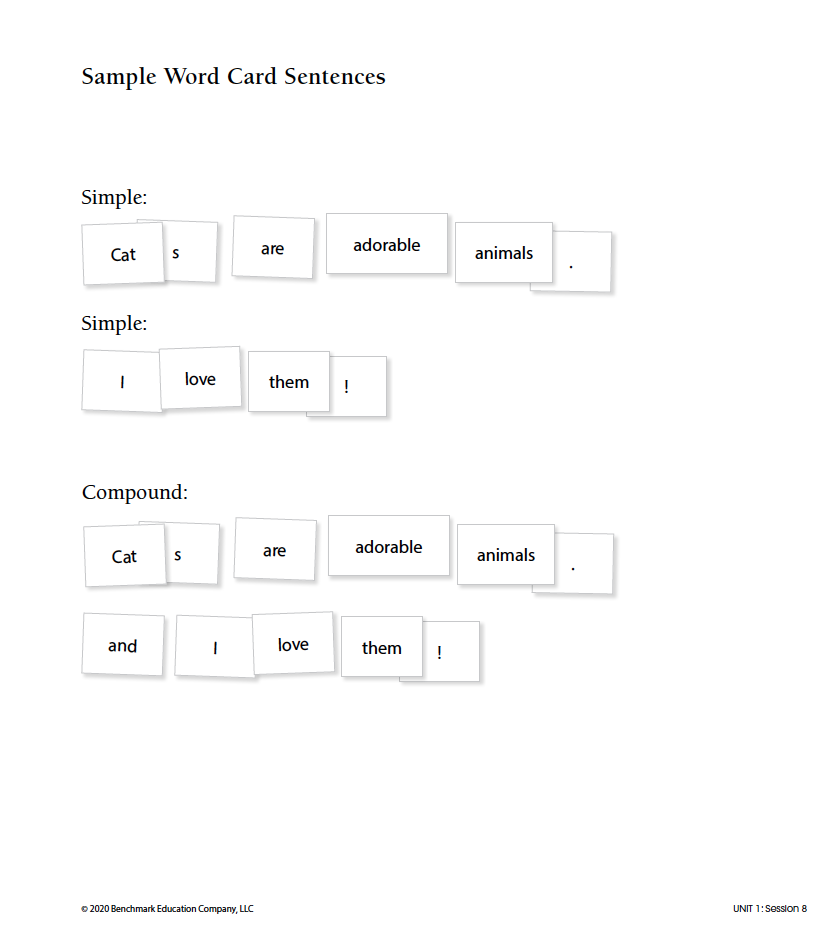
Playful grammar?  Yes, please!  One way to play with grammar is to use Grammar Word Cards.  These cards are a collection of different parts of speech, endings, and punctuation. Here’s how to use them:

  1. After printing out the cards, laminate so they will last for a long time.  Then cut the words out. Put in a baggie or envelope.
  2. Create partnerships or trios of students.  Ensure there are enough bags of words for each partnership or trio.  So if there are 20 students in your class, be sure to have about 10-word bags.
  3. Challenge students to use the Grammar Word Cards in different ways.  You might say:
    1. Build a compound sentence
    2. Build a compound sentence with words in alphabetical order
    3. Build a simple sentence that is more than ten words long
    4. Build a few simple sentences.  Combine them into a compound sentence.  Try to make them into a complex sentence.

Tip!  In lieu of correcting students if their attempts are off-base, challenge students to find and correct the error.  For example, if there is a comma missing in a compound sentence say, “That is almost a compound sentence. There’s one more thing you need.” Encourage students to problem solve.

These five simple yet powerful instructional moves will have a huge impact on how students use grammar as their artistic tool to mold, construct, and shape their writing. 

Go teach grammar brilliantly!

Learn more about Patty McGee- Click here!

Loading

The Power of Patterns in Teaching

By Tim Rasinski

The world is full of patterns. When we see a red octagonal sign while driving, we immediately think, “STOP!” Football fans can instantly recognize the shape of a goalpost and know what it’s used for. And when we hear the melody to a familiar song (think “Wheels on the Bus’ or “The Star-Spangled Banner”), we immediately recall the words. If you have a dog or cat at home, you are probably attuned to the pattern of the barks and mews. Indeed, look around the room in which you are in right now, and your are likely to see many patterns—from the way the ceiling tiles or lights are arranged to the way the classroom desks are arranged, or to the pattern of the quilt covering the couch.

            Patterns can be defined as a regular and repeated arrangements of shapes, letters, lines, numbers, colors, and sounds that can serve as guides. As human beings, we are predisposed to detect patters in our environments. Our ability to see, hear, feel, and identify patterns makes our lives safer, easier to negotiate, and more productive.

            Besides the types just mentioned, linguistic patterns can be used in teaching reading and writing. Of course, the letters of the alphabet and phonemes they represent are among the first patterns we teach children. Interestingly enough, we often teach the letters to young children with a song—The Alphabet Song—which itself is a patterned text.

However, there are many other patterns that can be used in teaching reading—patterns that can make learning more productive and more efficient for students. In this blog, I will share a few that I found to be very helpful in teaching children to read in the Kent State University reading clinic: Camp Read-A-Lot.

Help Students See Word Patterns: Phonemic Word Families/Phonograms/Rimes

One of the most widely used linguistic patterns taught in the primary grades are the phonemic word families—also known as phonograms or rimes. A phonemic word family is a part of the syllable that begins with the vowel (every syllable by definition needs to have a vowel or vowel combination) and all other letters that follow the vowel represent a regular or consistent set of phonemes or language sounds. For example, -each in ”teach”, and the –ent in the second syllable of “student” are word families. The significance of word families is that they are regularly occurring letter patterns that represent regularly occurring sound patterns.  Not only does knowledge of –each help a developing reader decode the word “teach,” but it can also help students decode “beach, breach, peach, preach, reach” and even longer, more complex words: “preacher, teachable.” Indeed, in a seminal article, Dr. Edward Fry identified thirty-eight-word families, knowledge of which allows readers to decode over 650 single-syllable words. Moreover, the number of multisyllabic words that can be decoded from knowledge of these letter patterns is in the thousands. For example, the word family –am finds its way into ambulance, camera, family, hamster, and many more.

            If we have this natural ability to see patterns, why not use them with students in our teaching of phonics and word decoding? Dr. Fry’s thirty-eight-word families could easily be taught once per week in first grade. Students would leave with the ability to analyze and decode a multitude of English words.

Edward Fry’s Most Common Phonograms

-ab         -at        -ink       -ore                           -unk
-ack       -ay       -ip         -ot                              -y
-ag         -ell       -ight      -out
-all         -est       -ill        -ow (how, chow)
-ain        -ew       -im       -ow (bow, throw)  
-am        -ed        -in        -op
 

Enlarge Students’ Vocabulary With Morphemes – Word Roots

Phonograms or word families are not the only letter patterns worth teaching. Morphemes are word parts or patterns that not only represent a consistent or regular occurring sound, they also represent meaning and, as such, are well worth teaching if your goal is to expand students’ vocabularies or knowledge of word meanings. Another common name for morphemes is roots. Some of the most common morphemes in English derive from Latin and Greek. The logic behind the use of morphemes in reading instruction is the same as with teaching phonograms—knowledge of one morpheme can help students unlock the meaning to many words—in some cases over 100 English words.

            The numerical prefix bi– can be found in English words such as bifocals, biplane, bicycle, biannual, bipartisan, and many more. Similarly, base word roots, morphemes that are the foundation of words, help form the meaning of many English words. Knowing that ject- means “to throw” can help students determine or affirm the meaning of words such as: eject, inject, object, object, reject, interject, conjecture, and many more. Indeed, it has been estimated that the word root trac/tract, meaning pull, draw, drag, is found in over 140 English words! Moreover, most of our multisyllabic words in English as well are academic words (think science, social studies, mathematics) are made of morphemic word roots.

            Again, the logic then suggests that teaching a limited number of morphemes or word roots can give students patterns that will allow them to determine the meaning (and sound representation) to a near-limitless number of English words. Then, teaching morphemic word patterns should be seen as the natural follow-up to teaching phonemic word families or phonograms. (Find out more about teaching word roots in my blog article: “A Little Latin (and Greek), and a Whole Lot of English Building Vocabulary with Word Roots,” on the Robb Review – https://therobbreviewblog.com/uncategorized/a-little-latin-and-greakk/

Teach Reading With Poetry: Use Textual Language Patterns

Beyond individual word patterns, we also have language patterns that exist at the text level. Of course, when talking about teaching reading to children, I am referring to poetry for children. Poetry, and I’m including song lyrics as well, follow highly predictable patterns in terms of rhythm and rhyme. That is why poetry, especially poetry and rhymes for children, is so easy to learn. Nearly all children in primary grades can easily recite a plethora of nursery rhymes, poems, and song lyrics. How many of us, as adults, can easily recall song lyrics and poems that we last heard years ago? The textual patterns make them easy to remember.

            When working with younger readers, we want them to meet success in learning to read. What better way to ensure success to learn to read poems or other patterned texts each day or two. Of course, such learning requires repetition, and repetition (repeated reading of actual texts is a hallmark of reading fluency development.

            One more thing that’s worth noting about poetry for children: most poems rhyme. Returning to what I had previously mentioned, words belonging to particular word families (phonograms or rimes) generally rhyme. So, the use of poetry as a way to develop fluency and success in reading connected text can also be sued as a wonderful way to follow up word family phonics instruction. After learning the –eep word family and associated words, your students can read, reread, and eventually perform Little Bo Peep. Instruction with the –ick and –ock word families can be followed with Hickory Dickory Dock.

            In Kent State’s Camp Read-A-Lot reading clinic, where young students make remarkable progress in reading in as little as five weeks of instruction, our goal is for students to learn to read something well each and every day of instruction. And that something is usually a poem or a song. Moreover, the poems and songs that students learn are usually tied to the phonemic word families they are also learning.

            Sometimes our teachers/clinicians are unable to find a poem along with a word family under instruction. In such cases, the clinicians write their own poems. One added benefit of poetry is that the patterns in poetry can easily be parodied to write new poems that follow the patterns of already-known poems. For example, the nursery rhyme “Diddle Diddle Dumpling My Son Jon” was rewritten by a clinician to reinforce the –ag word family:

                        Diggle daggle dumpling, Aggie and Mag

Had a dog, and his name was Tag

Tag had a tail that would wiggle and wag

Diggle daggle dumpling, Agnes and Mag.

Imagine the sense of accomplishment Taylor felt as he stood in front of classmates and family members to perform his own poem. Teaching and learning doesn’t get any better than that!

            Find out more about teaching and using poetry in my blog article: “Why Poetry, Let Me Count the Ways,” on the Robb Review: https://therobbreviewblog.com/?s=poetry

References and Resources

Fry, E. (1998).  The most common phonograms.  The Reading Teacher, 51, 620-622.

Harrison, D., Rasinski T.V., & Fresch, M. (2022). Partner Poems & Word Ladders for Building Foundational Literacy Skills: Grades K-2 and 1-3. New York: Scholastic.

Rasinski, T. V., Padak, N., Newton, R. & Newton, E. (2020). Building Vocabulary with Greek and Latin Roots: A Professional Guide to Word Knowledge and Vocabulary Development (2nd ed.). Huntington Beach, CA: Shell Educational Publishing. (Professional Development Book)

Rasinski, T. V., Padak, N., Newton, R., & Newton, E. (2019). Building Vocabulary from Word Roots. Huntington Beach, CA: Shell Educational Publishing. (Vocabulary Instruction Kit for Grades K to 11).

Loading