
The Writing Teacher – Student Partnerships

I asked Laura to share her thoughts on how an English teacher can create a culture of feedback by supporting student partnership.

Reading and grading papers is a fact of the teaching life. However, writing teachers seem to spend more time on students’ work because they provide students with lengthy revision suggestions and correct most of the students’ incorrect use of conventions.  Frustrations over workload and time spent grading quickly set in, but these feelings go underground when you organize writing partnerships in your classes.

Students can select writing partners or you can assign them. However, offering students choice motivates them to work hard and support each other through the process. Since partnerships can change after completing a writing unit, students will be able to pair-up with several classmates during the year. In addition, if a partner is working diligently on a draft, encourage students to seek assistance from someone who has completed that part of the process.

Writing partnerships benefit teachers and students, and the suggestions that follow provide tips that help you place the responsibility for writing plans, drafting, revising, and editing on students.

Supporting Student Partnerships. Collaborate with students and motivate them to write, and at the same time, you’ll boost their engagement in the entire process.

  • Create the rubric with student input so that they invest in the process.
  • Negotiate with students the amount of time they need for each of the following parts of the process: designing a rubric with you; brainstorming and planning; composing the first draft; revising for content and style; and editing for conventions.
  • Circulate among students when they brainstorm, plan, and the draft so you can discuss questions and roadblocks with them and offer suggestions that move them forward.
  • Read and offer feedback on second drafts, for these have been greatly improved by students.
  • Use the rubric to make positive comments on a sticky note and ask one to two questions that push students back into the revision and/or editing process.

Releasing Responsibility to Students Partnerships. Students learn how to evaluate a piece of writing by comparing it to a rubric. Have students write self and peer evaluations on notebook paper and file these in their writing folders.  Make sure students save all of their written work–from brainstormed ideas to second drafts–in a writing folder.

  • Have students discuss their topics before brainstorming. This ensures that they generate more detailed lists.
  • Ask students to use their rubric to evaluate the richness of details in their writing plan and add specific details when necessary.
  • Have students use the rubric to self-and-peer evaluate first drafts by measuring these against the negotiated rubric.
  • Help partners understand that first drafts require much work. Encourage them to revise for content first, then writing style, and finally for conventions.
  • Have students use their revisions and edits to compose the second draft.
  • Require that students turn in all of their work with the second draft on top.

The Payoffs

  Teachers find it easier to grade and offer feedback on improved second drafts. Moreover, student partnerships free-up teachers with the time they need to support individuals who struggle with a task.  

Partnerships foster independence in writing among students. When they experience how comparing a draft to the rubric provides them with suggestions for improving their piece, they can choose and use feedback to revise and rewrite their writing.
Loading

Leadership: Build Commitment!


Leaders who can build commitment towards a well-articulated vision and common goals have much better odds of achieving success. Whether you are a principal, executive, teacher, or coach you will face choices that define your leadership, communicate your core values, and the values of your school or organization.  Your choices have the ability to draw people to you, away from you, or cause people to fear you. This is a big responsibility, and one of the many that come with any leadership position.

One’s position, at times, can allow the use of positional authority to make someone do something. Beware the lure of positional authority; making people do things does not build commitment. Many times people need a job and will allow themselves to be treated poorly just because they need the job. Such a style of autocratic leadership will never build a staff committed to a vision and goals. This is compliance based leadership. Yes, it makes people “do” things but it cannot make people care.

Effective leaders, schools, and organizations  build commitment to a vision, goals, and their personal “why.” Effective leaders know that people who care and are committed to a vision and goals are always better team members.

I will present several reflections on how well you, your school or organization are building an environment of commitment VS an environment of compliance. Let’s start with what you have the most control over, yourself, followed by your school or organization.

A Personal Path

Would people with whom you work say you are trustworthy, a person of integrity? This is a complex question, at the core a repetition of you doing what you say you will do time and time again. Such consistency of the leader helps to build trust and organizational commitment. This strategy and skill will help a leader, assuming the leader is making decisions in alignment with a shared vision and goals. Without trust, you cannot lead. Lack of trust grows when people see or feel a disconnect between what you say and what you do.  

  • As an educator, if you believe in putting students first, and I hope you do, ask yourself: Do your actions support this belief or create contradictions?
  • Are you making daily decisions that are in alignment with a shared vision and goals or in opposition?
  • A simple but important question: Do you know what the vision and goals are?

An Organizational Path

On an organizational level, the organization and leaders within will be collectively challenged when employees see a disconnect between what the organization communicates as its core values and the actions of those who lead in the organization.  This type of disconnect can breed a cynical attitude from the employee and will not lead to creating a commitment to the values and beliefs of the organization.

  • Is there congruence or disconnects between the vision and goals of your school or organization and how employees view the vision and goals?  
  • What can you do, as a leader, to help create better alignment between what is communicated organizationally and how staff perceives it?
  • Do employees know the vision and have a general understanding of the goals?

No organization, school, or person will find greatness by making people do things. Such actions will always be the essence of a compliant organization.  There are two challenges to consider: (1) work towards decision making congruence between vision and goals; (2) frame your actions and decisions around your personal “why” as you work towards building an engaged and committed team.  

People become engaged and committed when they believe in what they’re doing and believe they are making a difference. This deep commitment brings out the best in employees and staff.   

Please check out my book, The Principal’s Leadership Sourcebook


The Principal’s Leadership Sourcebook


Loading

The Writing Teacher- Effective Leads

This blog grew out of discussions Laura and I had on teaching students how to write effective leads.  As we like to do, we are sharing ideas you can try immediately in your class or school.

What makes students want to continue reading? One key element is the lead or introduction because it can create a desire to read more. The first few sentences of book or story should grab the reader’s attention and make him or her wonder.

When you teach students how to open a story or essay, they start writing lackluster openings such as I’m going to tell you about whales or I’m going to write about my best friend. These leads are snoozers and typical of students who have not been taught what makes a lead engaging and motivates them to continue.

Leads That Work. Leads that activate the voice within readers that says, ”Keep reading!” have important jobs:

  1. The lead prepares readers for what’s to come in the text.
  2. The lead raises questions that can be answered if the learner reads more.

Students can use both elements to evaluate and improve their own leads.

Five Leads Worth Teaching.

1.Lead with a question that doesn’t have a “Yes’ or “No answer.

Example:  Why did Jack cancel today’s hike?

2.Lead with a dialogue that’s short and arouses curiosity.

Example:  “She’s running from the bakery, with a loaf of bread inside her jacket,” a man shouted.

“One more block and I can ditch into an alley,” the girl muttered.

3.Lead with a short anecdote or story that captures readers’ imagination.

Example:  She stared at her cat–her pet for nine years. How could she hold her beloved Angus while the Vet ended his life?

4.Lead with a fascinating fact that increases readers interest.

Example:  The giraffe is the tallest mammal in the world, and their newborn giraffe babies are taller than human babies.

5.Lead by setting a tone or mood to draw readers into a text.

Example:  The house looked strange. Black paint covered the windows. Suddenly, the front door flung open, yet neither human nor animal stepped onto the rickety porch.

Create Mini-Lessons for Each Kind of Lead

One-at-a-time is the rule for introducing leads. The suggestions that follow can support your lessons.

  • Explain both jobs of a lead.
  • Name the lead you’re going to model.
  • Write an example for students to study and discuss or use an example from a book.
  • Think aloud and show how the lead introduces the piece and write the questions the lead raises on the board.
  • Organize students into pairs.
  • Invite partners to craft a sample lead and discuss the questions it raises.
  • Encourage students to share their leads with the class.

Now you can show students how to craft leads that draw readers into a text.

Remember, that first draft leads are usually not terrific. So, ask students to return to their openings and use what they’ve practiced as they work to improve their writing skills!
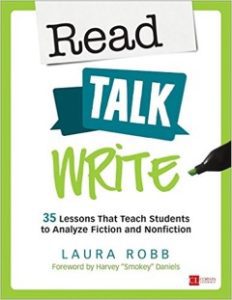
Learn more about leads, introductions, and writing from Laura Robb’s book, Teaching Middle School Writers Heinemann, 2010.

Loading

Leadership: The Power of Positive


My second blog is on leadership and discusses a simple concept, one that will test you each day: The power of being a positive person–a positive force in your school. Administrators who daily utilize a positive approach can effect and even transform a school’s culture.

So, now for the look-in-the-mirror-moment. Ask yourself, Am I a positive person? Then, reflect on both statements: Positive people always attract positive people. People who are negative tend to attract negative people. Some people believe they are positive and feel perplexed when they attract negative people. But everyone has the power to change their outlook to positive as long as each person sees the need and has the will.

After many years in education, I can honestly say that I have known many negative people, including school and district leaders. However, I have also known leaders who continually maintain a positive outlook because they understand that being positive is a key ingredient for success. When school leaders combine positivity with a passion for their work, it’s possible for them to achieve greatness. Both positivity and negativity affect people’s interactions and their view of life and the world. Moreover, I have never known a negative leader who has achieved success over time, but I have observed positive leaders do this again and again.

My challenge to you is to be a positive force. By embracing a positive outlook, you will be a more effective leader and impact teachers, staff, students, and families. In addition, your leadership style holds the potential of creating an upbeat outlook among teachers who in turn develop a positive class environment for students. To support your efforts, I’ve identified four simple rules for you to consider:

  1. Make the choice to be a positive force.
  2. Be upbeat and optimistic and look for what works as well as focusing on what others do well.
  3. Bring a positive outlook to negative people by modeling the benefits.
  4. Practice being positive every day.

Embracing a positive leadership style may be the best advice I can give you because you will create meaningful change by building on what’s working. Remember the opening of Johnny Mercer’s popular song, “You’ve got to accentuate the positive. Eliminate the negative. Latch on to the affirmative. Don’t mess with Mister In-between.” This song has been recorded by artists such as Bing Crosby, Paul McCartney, Connie Francis, and Aretha Franklin for good reasons–it celebrates the power to affect positive change by having an upbeat outlook.

I believe that effective leaders are positive. If you inherit a negative school culture, being positive can raise feelings of loneliness. However, by recognizing the reasons for these feelings, you can make the choice to be positive during each day. To maintain a positive school culture, notice and give voice to the excellence you observe as you complete walkthroughs, spend time in the cafeteria and classes, walk your school’s halls, meet with staff and parents, attend school and district meetings, and watch sports and arts events. Keep in mind that change will come because like the common cold, being positive is catching!


My book The Principal’s Leadership Sourcebook is available on Amazon.


Loading