Author: Laura Robb

Is Every Student a Protagonist in Your Classroom Library?

By Laura Robb and Evan Robb

Classroom libraries can be conduits for change, providing all children access to texts that affirm who they are, open possibilities for what they can become─and help them to develop the habit of reading. Teachers have tremendous power to amass text collections that develop students’ academic, emotional, and social selves. In this blog, we share the ins and outs to create a classroom library that adds joy to your school days─and affirms for all children that they belong.

The academic payoff of classroom libraries is old news…

There are decades of research to support the adage that children get better at reading by reading. In fact, whether you are a teacher or a leader reading this blog, we encourage you to use the research on why students become readers to advocate for funding classroom libraries. Developing successful, lifelong readers has everything to do with reading volume, offering students choice in what to read, and using outstanding children’s and young adult literature (Allington, 1997, 2012, 2014; Anderson, Wilson, and Fielding, 1998; Krashen, 2004). Yet, it’s important to acknowledge that we are all newbies regarding how to use books in ways that align with culturally sustaining pedagogy.

…but how teachers create an optimal collection is breaking news

Regardless of background, all teachers need guidance and assurance on finding books that provide positive, identity-building stories for all children. The field of culturally sustaining literature has exploded in the last few years, and the benchmarks have shifted. For example, publishers have recognized that it’s not enough to show characters of color or sprinkle them into storylines; they need to seek out own-voice writers and illustrators representing a wide range of ethnic, cultural, and religious backgrounds.

Children want to see themselves as protagonists, not slated to secondary characters. All children crave involving, entertaining, and nuanced stories and themes; they want normal, not noble. They know darn well when a book is pandering to stereotypes rather than written from an authentic perspective.

Luckily, great books in just about every genre abound! Tap the expertise of your school librarian and see the box below on a few of our favorite sources for diverse literature. Then, use the tips that follow to build the classroom library of your dreams.

1. Define diversity

Having a working definition of diversity helps you gather a strong collection. For example, you want to think about diversity in terms of abilities, race, ethnicity, culture, home language, gender identity, and so on. You want to reflect on what it means to shift away from assuming that white, middle-class, English-speaking is the norm. It’s not. Diversity is inclusivity. It’s not just about cultural and ethnic breadth.

2. Be asset-based

How you select a read-aloud, and how you talk about book characters, influences students’ sense of one another and themselves. For example, if you have bi/multilingual students in your classroom, select books that reflect their backgrounds and celebrate those learners’ ability to develop more than one language simultaneously. Also, pose questions in ways that are open-ended and invite all kids to respond. “What is familiar here?” “What is the character realizing now?” Older books in your current library? Scrutinize them to make sure they don’t perpetuate negative, patronizing stereotypes.

3. Be ruthless about relevance

What engaged you in terms of topics and authors as a youth might not resonate with most children today. So, fill the shelves with books that are relevant to students’ interests and life today.

Related Content

Collage of Best Eighth Grade Science Projects and Experiments

40 Great Eighth Grade Science Fair Projects and Classroom Experiments

Collage of Winter Science Activities

30 of the Coolest Winter Science Experiments and Activities

40 Ways Teachers Can Make Extra Money

4. Consider reading range

Include lots and lots of books on grade level, but plenty below and above grade level.

5. Go big or go home

Each classroom library should have a minimum of 600 unleveled books and a goal to increase the collection to 1,000-1,500 over a couple of years. Pumping up students’ reading volume requires a voluminous approach to books. A few favorite diversity resources:

  • Lee & Low Books, which was founded in 1991, is now the largest multicultural book publisher in the United States.
  • Reycraft Books, a relatively new book line, publishes and licenses books for all children by authors and illustrators around the globe that have unique stories to tell.
  • Wordsong is this country’s only imprint dedicated to publishing children’s poetry.
  • Versify is a children’s imprint launched by award-winning author Kwame Alexander. It publishes books that celebrate the lives and reflect the possibilities of all.
  • We Need Diverse Books is a nonprofit organization of book lovers that advocates essential changes in the publishing industry to produce and promote literature that reflects and honors the lives of all young people.
  • The Brown Bookshelf is designed to push awareness of the myriad Black voices writing for young readers. Their flagship initiative is 28 Days Later, a month-long showcase of the best in Picture Books, Middle Grade, and Young Adult novels written and illustrated by Black creators. You can read more about the members of The Brown Bookshelf here.
  • Penguin Random House Creative Writing Awards (CWAs) is a scholarship program designed to highlight, encourage, and support diverse student voices. Eligible for high school seniors, please visit the link for more information.
  • Corwin Press has an equity line of professional books for teachers and leaders. Launched by Dan Albert more than 20 years ago, its authors have been at the forefront of culturally sustaining pedagogy.
Each classroom library should have a minimum of 600 unleveled books and a goal to increase the collection to 1,000-1,500 over a couple of years. Pumping up students’ reading volume requires a voluminous approach to books.

6. Stock all text types and genres

Use these ideas (and the linked book lists) to help you make your library diverse in terms of genres.

  • Poetry
  • Picture books
  • Graphic novels/manga
  • Realistic fiction
  • Historical fiction
  • Science fiction
  • Fairy tales (include renditions authored and illustrated by people of color/representing versions of the tale from various countries/cultures)

14 Genres to consider adding to your classroom library.

7. Connect instructional and independent reading

The classroom library should feel recess-like recreational to students! You want them to view books as a break from some of the tasks and learning at school that might be harder for them. That said, as you plan your units, from ELA to math, to science, to history, add books to the library on topics your curriculum addresses.

8. Keep the library kinesthetic, not static

As the teacher, you are wearing the hat of the bookseller. And as every bookseller knows, the secret to success is to entice browsers with appealing, new features. Students will love it! Invite students to help you organize the library at the start of the school year. Hand out a student reading interest survey, so you discover kids’ interests and what kinds of books they like. Every few weeks, layer in newness.

For example, display “This week’s picks” and invite students to do the same in subsequent weeks. Place a box in the library for students to make anonymous suggestions for books, topics, authors; sometimes kids are too shy to ask for a topic publicly. Invite students to schedule 60-second book talks to promote favorites to peers. Invite your principal to get on the school’s intercom once a week and tell about a favorite book, and have students also share favorites that way.

 9. Advocate for classroom libraries

We believe that with a little ingenuity, any teacher can develop a class library, even in schools whose leadership don’t see classroom collections as a priority. Advocate for the principal to shift budget money allocated for a new reading program to stocking every classroom with an abundance of books. Collaborate with other teachers to make classroom libraries a school-wide initiative, a badge of honor!

10. Collaborate and coach one another

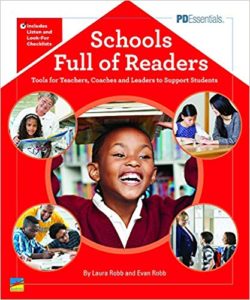
Launch a professional development inquiry around best practices for cultivating independent reading. To help you and others develop excellent practices throughout the school, use the following checklist. (Many more checklists can be found in our book Schools Full of Readers.)

Is Your Classroom Library Culturally Sustaining?

What tips do you have to create a classroom library? Share in the comments below.

Is Your Classroom Library Culturally Sustaining?

Loading

Improve Students’ Fluency, Vocabulary, & Comprehension with Guided Practice

By Laura Robb

“The kids who can’t read the grade level text listen to it so they are on the same page as students who can read the text. That’s the only way I can have every student experience the required text.” This explanation illustrates how a sixth-grade teacher coped with a one-novel per semester curriculum in her classes. None of the teacher’s three ELA sections had all students reading on grade level or above. In fact, in this school students in all ELA classes, excluding two gifted and talented classes, were reading from grades one to seven —a range that’s similar to many middle schools throughout the country. 

            Despite the fact that teachers have classroom libraries and students read self-selected books for fifteen minutes each day, students reading three or more years below grade level don’t make enough progress in one year to learn from social studies and science textbooks.  In fact, these developing readers, often feel discouraged throughout the day because they can’t read texts in content subjects and therefore, don’t fully participate in discussions.

            More than forty years ago in his article, “If They Don’t Read Much, How Are  They Ever Gonna Get Good?” Richard Allington affirmed my observations and beliefs for developing readers: to improve their fluency and comprehension as well as enlarge their vocabulary and background knowledge, they need to read engaging, authentic materials throughout the day (1977).  Middle school is, most likely, the last opportunity teachers have to meet the needs of developing readers and by eighth grade have most students reading on or above grade level.  

When ELA and content area classes have books that represent students’ interests, cultures, and reading levels, students can read all day, every day. Equally important, as they improve reading skill and successfully participate in class discussions, students develop self-confidence and the perseverance to improve their reading. In addition to volume in reading, developing readers benefit from short, guided practice lessons that can also improve reading skill.

The Why Behind Guided Practice

Guided practice is instructional reading using a poem or a short text, and you facilitate the lessons that can be completed in 15 to 30 minutes. If you’re unsure whether students have absorbed information from a series of mini-lessons, you can use guided practice lessons to gain insights into their level of understanding. Moreover, during mini-lessons, you might identify a group of students who require additional practice. By supporting students with guided practice lessons, you strengthen their fluency, word knowledge, writing about reading, increase their background knowledge, and improve their recall and comprehension. How students navigate short texts can inform your instructional decisions, as you can:

  • Adjust instructional moves by re-teaching a lesson or tweaking students’ goals and workload.
  • Present one or two additional guided practice lessons to provide students with the practice that can improve their reading skill.
  • Confer with a student to deepen your understanding of his/her work.
  • Support a student or small groups by asking them to explain their thinking and then think aloud to model your process and gradually release the responsibility to students.
  • Pair-up students and ask them to support one another as they rethink and redo notebook writing.

By observing students during guided practice lessons, you can target interventions and bring all students to a level of understanding that allows them to experience success during instructional and independent reading.

Scheduling Guided Practice

Guided practice Lessons replace all or part of your instructional reading block over two to three consecutive days. You can reserve one week to present a lesson and use it to assess students, or you can set aside three to four weeks and use the guided practice lessons as interventions that boost students’ reading skill.  Guided practice does not occur all year long and daily formative assessments provide the data that informs decisions and schedule adjustments. I have developed two types of guided practice lessons for additional reading practice.

Two Types of Guided Practice Lessons That Work

Both types of lessons build vocabulary, recommend short videos to enlarge background knowledge, invite students to reread passages for different purposes, improve fluency, and provide practice with citing text evidence to infer and support a position.

Partner discussion lessons ask you to do more explicit teaching by modeling how to write notebook responses and use context to determine the meaning of words. Pairs collaborate to complete word work, discuss questions, and choose a prompt to write about in their notebooks. These lessons offer students practice in completing authentic reading tasks and rely on partners scaffolding tasks for each other.

Shared reading lessons invite students to solve reading challenges independently (Burkins and Yaris, 2018).  These lessons ask you to select texts that allow students to solve reading problems independently.  As you pose questions about a short text, you’ll drive students into the text to infer, explore themes, compare and contrast, and enlarge their vocabulary. It’s the students doing the work that develops stamina and confidence to enjoy independent reading at school and home.. 

After students have completed a guided practice lesson, take some time to reflect on your observations and students’ questions and responses.  Doing this can help you decide if all or some students need extra practice with a specific strategy or if you can move on to building students’ reading skill and independence.

Learn More About Guided Practice Lessons

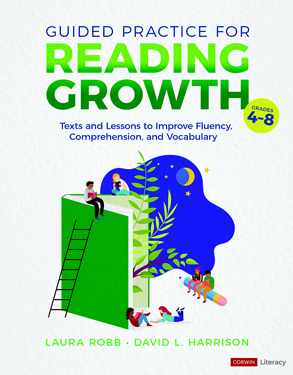
Corwin Literacy has published a book by Laura Robb and David Harrison, Guided Practice For Reading Growth (2020) that includes partner discussion and shared reading lessons for twelve poems and twelve short texts written by David Harrison, so children practice using beautifully written and engaging texts. Below is a shared reading lesson from the book that you can use with your students.

Rain, She by David Harrison

Rain, she watch jungle.
Oh yes!
Rain, she slyly lift each leaf,

tiptoe down trunk of kapok tree,

make sure jungle nice and green.

2Rain, she know when jungle thirsty.

She bang on forest roof,
plunk rubber trees on their heads.

“Wake up! Drink!” she say.

Oh yes!
Rain, she plump up blossoms,
make them nice and fancy for thirsty bees.

3Rain, she not forget animals!
Oh no!
She drench fur of sullen jaguar,

make parrots shake their feathers,

drip off howler monkey’s nose.

Oh yes!

4And rain, she never never forget
to pelt and rattle thatch huts,
drip through cracks, trickle down walls.

“Ha!” she say. “This I do for you.
I keep river full, she happy,
I pour your squash a drink.”

5Then rain, she say,
“This I do for me.
I keep jungle nice and green.

Oh yes!”

SHARED READING OF THE POEM, “RAIN, SHE”

Purpose: To understand how personification and onomatopoeia enhance meaning and support visualizing

Lesson Materials:

  • Copies for all students of “Rain, She”
  • Students file folders for storing short texts; 4 x 6 index card for covering stanzas
  • An anchor chart headed with the title of the poem. Post both sentences on anchor chart:  Personification is giving non-living things the ability to do what humans can do. David Harrison personifies rain by making it a woman who cares for the rainforest. 
  • Make two columns on the anchor chart. Title left side “Strong Rain Verbs” and title right side, “What You Picture.”
  • Video: “Rain Forests 101/National Geographic” (3:41) or another video about rain forests that’s appropriate for your students. https://youtu.be/3vijLre760w >

Part 1. Pre-Teach

Day 1: about 15-20 minutes

  • Watch video “Rainforests 101/National Geographic.” (You might want to watch this twice).  Invite students to share all they remember. Discuss green canopy and ecosystems.

● Show photo of the Kapok tree. Have students look at the person compared to the size of the tree. Connect Kapok tree to the green canopy and point out the animals that live in the tree and connect that to ecosystems. A great online resource can be found here: https://www.rainforest-alliance.org/species/kapok-tree

  • Ask students to head a page in their notebooks and explain what the “green canopy” of the rainforest is and why it’s important. Circulate and help students by answering questions or helping them frame responses.

Day 2: about 15-20 minutes

read silently.

  • Read the sentences on the anchor chart for personification and personifies. Model how you use clues to figure out the meaning of personification. Invite students to explain personifies using sentence clues.
  • Have students turn-and-talk and discuss the meaning of these words using context clues.
  • Reread the title and ask students to explain how David Harrison personifies rain.
  • Reread the poem and ask students to turn-and-talk and find other examples of rain being personified as a woman.
  • Introduce onomatopoeia and explain that words that also create sounds are onomatopoeic words. As an example point to bang in the second stanza. Ask, What kind of noise does bang make?
  • Have students find other words in the poem that also make sounds: plunk, shake, pelt, rattle

Part 2. Start the Shared Reading Lesson

Day 3: about 20-30 minutes

  • Have students retrieve a copy of “Rain, She” and the 4 x 6 index card from their folders. Students use their index cards to cover up stanzas 3 to 5.
  • Read stanzas 1 and 2 out loud. As students follow silently, have them spot words that show what “she” does.
  • Have students turn-and-talk, share words, and write these on the left side of the anchor chart.

First and Second Stanzas

How do these words (watch, tiptoe, bang, plunk, drink, plump up) help you see and hear what she is doing? Tell students these are strong verbs because they paint pictures and create sounds.

What other words in stanzas one and two relate to water?

  • Read aloud the rest of the poem and students read silently.

Third Stanza

What does she do for animals? What words show you this?

Which words are onomatopoeic words?

Fourth Stanza

How are people in the huts feeling about “rain, she?” Use details from the poem to support you ideas.

How does the rain help people?

Last Stanza

Why does rain say, “This I do for me.” How do these words link to what the poet is saying about rain in the rainforest?

  • What affect does repeating “oh yes!” have on your feelings? On the poem’s meaning?
  • Reread each stanza. Turn-and talk about the picture you see in your mind and the words and phrases that helped create these. Share with the class.

Wrap-Up: Notice what students did well: finding strong verbs, onomatopoeic words, visualizing, and offering text details.

Day 4:  about 15 minutes

Part 3. Teacher Assesses

Complete the Anchor Chart

Additions and adjustments come from the students. You’ll want to see what they can add. If they add little, then students are telling you they require more practice. You can redo part of the lesson or move on and slow down, checking frequently for understanding.

  • Have students retrieve the poem from their folders.
  • Ask students to choral read as you reread the poem.
  • Review anchor chart notes and have students make adjustments and add ideas.
  • Review green canopy, kapok tree, personification, and personify and connect to the poem.

Reflect and Intervene: On sticky notes, jot the names of students who didn’t participate or contribute ideas for the anchor chart. Work with individuals or a small group. Return to modeling and then invite students to respond.

References

Allington, Richard L. (1977). “If they don’t read much, how are they ever gonna get good?”Journal of Adult and Adolescent Literacy. 21(1), 57-61.

Burkins, Jan and Kim Yaris (2018). Who’s doing the work? How to say less so readers can do more. Portland, ME: Stenhouse.

Miller, Donalyn and Colby Sharp (2018). Game changer! Book access for all kids. New York, NY: Scholastic.

Robb, Laura (2020). Guided Practice for Reading Growth, Thousand Oaks, CA: Corwin Literacy.

:Guided Practice for Reading Media Kit:Guided_Practice_Cover.tif

Loading

Independent Reading Always Matters

By Laura Robb

Most schools had twenty-four hours to close down. There wasn’t time to consider checking out books for students or ensuring each child had a computer or handheld device before leaving the building. During the sheltering-in period, no one could enter a school. Closed. For. Safety.  The first goal: provide breakfasts and lunches for the children. Within a week, school leaders figure out how to make meals available to students from preparing and bagging them to notifying parents of pick up times and places.

Second goal: Teachers and school leaders collaborate to figure out how to use technology in ways most never envisioned—to develop and deliver meaningful and engaging lessons to students at home. Daily, these educators tap into their creativity and innovative thinking to create engaging teaching and learning experiences for students.  School leaders offer support to their staff and repeatedly acknowledge the effort and dedication of teachers. Meeting change with courage, determination, grit, and thoughtful reflection is what educators do every day, but during this pandemic, they triple their efforts and work tirelessly to support children’s learning at home.

            Often, articles in newspapers express worries over students losing the gains made in reading if they’re not learning in schools.  There is one way to ensure that all students hold onto their gains in reading skill and achievement: twenty minutes of reading self-selected books every day. Yes! The research on daily independent reading indicates that if students continue independent reading at home, they can improve their reading skills.

 In April 2000 the National Reading Panel publishes a report stating that they couldn’t endorse independent reading because the studies they review don’t meet scientific research standards. What a blow to classroom teachers who year after year observe that students with rich independent reading lives at school and home also develop large vocabularies, more background knowledge, and outperform peers who don’t’ read independently.

The good news is that Dr. S. J. Samuels and Dr. Yi-chen Wu respond to the National Reading Panel by completing a scientific study on independent reading in 2004. Both conclude that the more time students spend reading, the higher their achievement compared to a control group.  Samuel’s and Wu’s scientific research corroborate the conclusions in Anderson’s, Wilson’s, and Fielding’s 1988 study (not considered scientific):  a strong correlation exists between the amount of daily reading students complete and their reading achievement. Reading volume matters!

Perhaps, the best advice teachers can offer students and parents during remote learning is this: read 20-minutes every day and choose books that provide pleasure and enjoyment. By increasing reading mileage, learners not only improve reading skills, but they also develop a lifelong habit that benefits them in the fifteen ways that follow. Share this list with parents, so they understand why setting aside time at home for their children to read gives each child a lifelong gift.

15 Benefits of Independent Reading

  1. Refines students’ understanding of applying strategies, for during independent reading, students have multiple opportunities to practice what they learn during instructional reading.
  2. Develops an understanding of how diverse genres work as readers figure out the likenesses and differences among realistic, historical, and science fiction, fantasy, mystery, thrillers, biography, memoir, informational texts, etc.
  3. Enlarges background knowledge and deepens readers’ understanding of people as they get to know different characters.
  4. Builds vocabulary as students meet and understand words in diverse contexts.  Independent reading, not vocabulary workbooks, is the best way to enlarge vocabulary because students meet words in the context of their reading.
  5. Teaches students how to self-select “good fit” books they can and want to read.
  6. Develops students’ agency and literary tastes. Choice builds agency and as students choose and dip into diverse genres and topics, they discover the types of books they enjoy.
  7.  Strengthens reading stamina, their ability to focus on reading for 20-minutes to one hour.
  8.  Improves silent reading. Through daily practice, students develop their in-the-head reading voice and learn to read in meaningful phrases.
  9. Develops reading fluency because of the practice that voluminous reading offers.
  10. Supports recall of information learners need as they read long texts that ask them to hold details presented in early chapters in their memory so they can access these later in the book.
  11. Improves reading rate through the practice that volume provides.
  12. Develops students’ imagination as they visualize settings, what characters and people look like, conflicts, decisions, problems, interactions, etc.
  13. Fosters the enjoyment of visual literacy when students read picture books and graphic texts.
  14.  Creates empathy for others as students learn to step into the skin of characters and experience their lives.
  15.  Transfers a passion for reading to students’ outside-of-school lives and develops the volume in reading students need to become proficient and advanced readers.

 Make Access to the Finest Books Available During Remote Learning

At first, it can feel impossible to cultivate daily independent reading during remote learning, especially when families don’t have access to books from school’s media centers and classroom and community libraries. Some families have lots of books in their homes and enough money to purchase books online for their children. But there are large groups of children all over the country who don’t have access to books at home and whose parents don’t have extra dollars to purchase them. What follows are four suggestions for coping with this challenge, especially if remote learning continues when the 2020-2021 school year starts.

  • Schools all over this country need funding for e-book libraries from federal state departments of education. It’s likely that students won’t return to school until there is a vaccine or medication that can cure COVID-19.  Now is the time for schools to consider purchasing at least two e-book platforms so students can self-select books.
  • Broadband needs to be up to speed so that all children can use the Internet and participate in remote learning.
  • Every child who attends public school needs a computer or hand-held device because every child deserves equity and access to materials and teaching.
  • School media specialists and teachers can create lists of stories, myths, poems, folk and fairy tales, and books that are in the public domain and offer students and parents age-appropriate choices. 

Be a Change Maker

Now is the time for school leaders, teachers, and staff to collaborate to solve challenges for the upcoming school year.  My hope is that this will be a nation-wide effort with a goal of ensuring that every child in this country has access to books and opportunities to self-select books, so they can develop a rich, independent reading life! 

Follow Laura on Twitter @LRobbTeacher

Follow Evan onTwitter @ERobbPrincipal

Follow The Robb Review Facebook Page!

Loading

Connecting Matters When We Work Alone

By Laura Robb

Teachers, school leaders, parents, and children are facing many challenges after states shut down schools to keep everyone safe during the COVID-19 pandemic.

The saying, “Necessity is the mother of invention,” has transformed educators, parents, and students into the pioneers of remote learning for primary, intermediate, middle, and high school students. We’re figuring out how to help different age groups learn and what kinds of materials teachers and students need. Time and schedules are issues.  Materials are issues.  Figuring out the WHY, WHAT, and the HOW of presenting lessons remotely are challenges we’re just starting to understand. Moreover, all of these are stress-makers that affect the emotional well being of teachers, school leaders, children, and parents. Here are some tips for maintaining balance and wellness.

  • Stay connected to family, friends, colleagues, and students through social media, email, texting, and telephone calls and you’ll be able to hold onto that physical sense of community you had to give up.
  • Get exercise. Walk, work out with a video, ride your bike, and try to get fresh air every day.
  • Set aside time to do something for yourself: read, watch a movie, listen to music, play an instrument, paint, keep a journal.
  • Try to establish a teaching schedule and know that you will have to refine and adjust ideas. Remember, you are a modern-day explorer trying to develop remote learning that works and redefining what community means!

Keep records of what you tried: save teaching videos, keep notes on lessons that worked and those that need improvement, collect student feedback, debrief with your school team, department, and/or colleagues you usually converse with.  Know how much students, parents, and your community appreciate what you are doing! Then, it’s important to prepare for the possibility that school might close again and discuss and reflect on re-envisioning teaching and learning.

Re-Envisioning Teaching: Remote Learning

It might seem odd for me to ask you to think about what might happen in the future now.  Unfortunately, due to the rapid advance of COVID-19, we were all caught with little preparation time.  Once things return to normal, it’s human nature to forget the difficulties faced by many. However, by keeping good records from your remote learning experiences, you will be ready to work with your school’s leaders and staff to help them plan for the future.  What follows are fifteen areas that will most likely need rethinking.  Read them. Choose those that apply to you and jot some notes that you can share so when your district is ready to discuss these, you will have much to contribute.

Fifteen Aspects of Remote Learning to Explore

  1. Preservice Education. Colleges and universities need to have remote learning classes for different subjects and age groups in order to prepare teachers to teach and support students online.
  2. Remote Professional Learning for School Leaders and Staff. It’s beneficial for staff to meet, and pool what they’ve learned from their remote teaching experiences. Equally important is for school districts to develop remote learning online classes teachers can take as well as lead.
  3. Create a School Pandemic & Epidemic Playbook. Develop “to do’s” for school leaders, teachers, staff, students, and parents so if you only have a short window prior to closing your school, everyone leaves with the materials they’ll need.
  4. Broadband for All. Ensure that all of rural America and urban families living in poverty have access to the Internet.
  5. Access and Equity. All students need to have access to computers and the Internet for equity and access to lessons to exist with remote learning.  District and school leaders need to explore ways to connect all school children to online learning.
  6. Attendance Issues. Districts need to determine ways to require attendance to online lessons.  Some teachers tell me that only 1/3 to 1/2 of their students are joining lessons even though they have computers.
  7. School E-Library. Consider having a part of the library’s books and magazines in e-book format, too. This can enable students to access books for independent reading and for research projects. Try forging a partnership with your community public library to gain access for students and teachers to their e-books.
  8. Independent Reading. You’ll want to maintain students’ volume and interest in reading.  Teachers can send books home with children before schools close, but schools can also explore websites that have e-picture books and e-chapter books for all subjects.  With students’ help, teachers can find ways for students to share one to two books a month online with classmates.
  9. Instructional Learning in All Subjects. Departments can collaborate to pool ideas and develop remote learning techniques that work when a teacher is not present.  Sharing what you find works with colleagues is important.
  10. Conferring.  Discuss whether this can occur for middle and high school where teachers can have 70 or more students. What accommodations should be made? What will it look like for grades K to 5?
  11. Interventions. These are important for all students who require assistance and some re-teaching. Will there be a daily time in the schedule? Will interventions be scheduled as needed?
  12.  Teaching & Learning Schedules. Make these reasonable and consider that most parents are working remotely or on a job. How can flexibility be integrated into schedules?
  13.  Television Classes. Look into state or county-run television stations to explore how these can be used for remote learning and reach larger audiences.
  14.  Teachers Meet & Dialogue. Finding time each week to have a virtual meeting to discuss teaching techniques and students’ progress.
  15.  School Leaders Provide Support. School leaders can explore ways to support teachers, students, and parents so all maintain a positive outlook.

Closing Thought

As you embark on this unchartered journey, let me share a reminder–care for your emotional wellbeing and your health, so you can support your students and colleagues, and also have time to connect with family and friends.  This is your new frontier! By collaborating and reflecting on your teaching and students’ learning, you will make a huge difference in their lives and construct the foundations of remote learning for future generations!

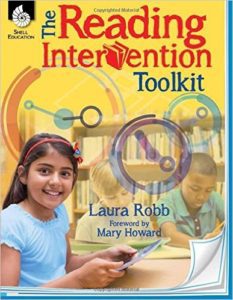
Laura has written many excellent books! Check out The Reading Intervention Toolkit

Teaching

Follow Laura on Twitter @LRobbTeacher

Follow Evan onTwitter @ERobbPrincipal

Follow The Robb Review Facebook Page!

Loading