David L. Harrison and Timothy Rasinski
In our previous blog articles for the Robb Review and elsewhere, we have written about the importance and advantages of poetry for children and how poetry should play a major role in any reading and language arts curriculum. In this current article, we would like to shift the focus from poetry to poets. In the United States, we are blessed with a wide variety of children’s poets, and just in the same way that students learn about the many authors of trade books for children, we feel that students (and teachers) should also learn about the fine poets whose trade is to write for kids.
Most of us have a favorite children’s poet or perhaps even a group of favorite poets. Often these include such great ones as Shel Silverstein, Jack Prelutsky, and A.A. Milne. As great as these poets are, the universe of wonderful poets for children is very large — and we would add worth exploring ourselves and with our students. Poets lead interesting lives that help inform their writing. As students learn of the lives of the poets they read about and hear, they may be able to make connections that will inspire them to write their own poetry.
Angela Knight is an elementary school librarian in Springfield, Missouri. Dr. Knight reads a poem aloud to the students in her school every week during the school year as her way to help foster an appreciation for poetry and encourage teachers to include poems in their daily classroom activities. We think her practice is brilliant in its simplicity and should be passed along to librarians, teachers, and all other adults who read to children.
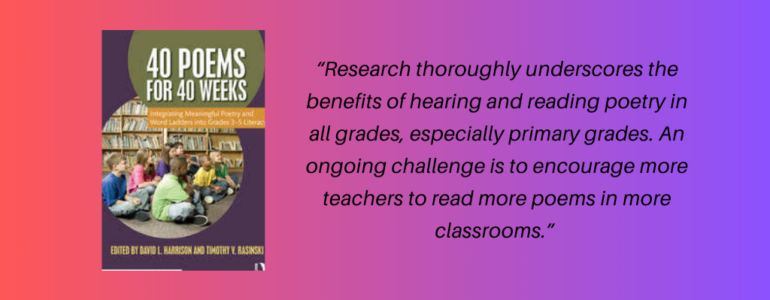
We’ve all watched long wriggly lines of young fans queue up to meet authors of their favorite chapter books or novels and become tongue-tied with adoration when they hold up their books for an autograph. Do kids line up like that, behave like that, in front of a poet? Perhaps some do, but in general, not so much. Yet in classrooms, when poems are read by teachers and students recite their own favorites, they learn to love poetry. Research thoroughly underscores the benefits of hearing and reading poetry in all grades, especially primary grades. An ongoing challenge is to encourage more teachers to read more poems in more classrooms.
The goal isn’t to make poets famous. It’s to make children (and the adults in their lives) more aware of poets as people. Why? Because the better we know someone, the more interesting they become. How do we do that? There are hundreds of books of good poetry for children available in schools and libraries. Many of them provide a thumbnail description of the poet. Nothing more. What is lacking is a way for students to get to know, more personally, the people who write their poems. Who are they? What were they like when they were kids? Why do they like to make up poems? How did they get started? Why is poetry so important to them? Where do they live? Do they like dogs?
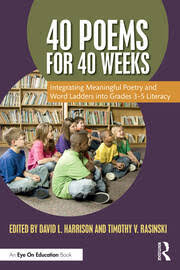
We discussed this challenge with forty well-known poets, all veterans of school visits and literature festivals. We agreed that each one would select or write a poem for our project. We would publish their picture on the first page and a kid-friendly bio on the second. We said, “Introduce yourself the way you do when you are in a school, standing before an audience of students and telling them about yourself.” The third page would feature their poem and a fourth would present a word ladder activity composed for each poem in the book. We asked each poet to suggest other books of poetry, their own or someone else’s, that they recommend for young people. The result was a reference reading list of more than 120 titles to go in the back of the book. The result, 40 Poems for 40 Weeks: Integrating Meaningful Poetry and Word Ladders in Grades 3-5 Literacy, was published by Routledge/Francis-Taylor in 2025.
We believe that moving poetry deeper into the mainstream of reading choices for young people, in the classroom and beyond, will develop a deeper appreciation for poets and the work they do. It will also have a positive impact on developing more fluent and proficient readers. We have found that poetry is an ideal text for developing fluency, the critical bridge from phonics to comprehension, as students must rehearse a poem (i.e., repeated readings) before performing it for an audience of classmates and others. Elementary educators often struggle to find the right materials to fit their instructional goals and schedules. 40 Poems for 40 Weeks, Integrating Meaningful Poetry and Word Ladders in Grades 3-5 Literacy provides a poem and poet for each week of the school year and can be selected in any order. We hope our effort to increase the popularity of poetry and the visibility of poets will inspire others to find ways to approach the goal. Instilling an appetite to read and developing proficiency in doing it remain our top priority as educators, parents, and the general population.
Poetry is rightfully reclaiming its place in the school reading and English language arts curricula. However, poetry does not exist without poets. Learning about the lives of poets who inspire with their poetry may inspire our students to give poetry a try in their own lives.
An excellent supplemental resource is a site called Poetry from Daily Life Free Video Library (https://www.youtube.com/@PoetryfromDailyLife-e2j). Sixty poets, teachers, journalists, editors, and professors have recorded their reasons why they believe that poetry is a vital part of our lives. Among the selections are numerous well-known, respected poets who write for children, including Jane Yolen, Joyce Sidman, Charles Ghigna, Janet Wong, Joseph Bruchac, and David L. Harrison, all of whom read a poem and talk about where they find ideas and how they write their poems. Educators who discuss how to make the most of poetry in the classroom include Laura Robb, Tim Rasinski, and Mary Jo Fresch.